


Cytotoxic Evaluation of Niclosamide via Saccharin-Based Multicomponent Crystal: Insights from in Vitro MTT Assay
Article Sidebar
Main Article Content
Abstract
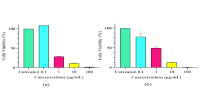
Breast cancer remains a major health burden among women globally. While targeted therapies continue to evolve, affordable and effective alternatives are still needed. Niclosamide, an FDA-approved anthelmintic, shows promise for drug repurposing due to its anticancer activity, though its poor solubility and bioavailability limit clinical use. To address this, cocrystallization with saccharin, a GRAS-status coformer, was employed to enhance niclosamide’s physicochemical properties without altering its pharmacological effect. This study evaluates the cytotoxic effect of pure niclosamide and the niclosamide–saccharin cocrystal on T47D breast cancer cells, synthesized via the solvent drop grinding (SDG) method and assessed using the MTT assay with microplate spectrophotometric analysis. The results demonstrated that both pure niclosamide and its multicomponent crystal exhibited cytotoxic effects on T47D cells. Notably, the niclosamide–saccharin crystal showed a lower IC50 value (0.90 µg/mL) compared to that of pure niclosamide (1.39 µg/mL), indicating enhanced potency. A significant decrease in T47D cell viability was observed, suggesting that the multicomponent crystal formulation may augment the anticancer efficacy of niclosamide. In conclusion, the formation of a niclosamide–saccharin multicomponent crystal significantly enhances its cytotoxic activity against breast cancer cells in vitro. These findings underscore the potential of cocrystallization as a strategic formulation approach to improve the therapeutic performance of repurposed drugs in cancer treatment.
Downloads
Article Details
Section

This work is licensed under a Creative Commons Attribution-NonCommercial-NoDerivatives 4.0 International License.
How to Cite
References
1. Sung H, Ferlay J, Siegel RL, Laversanne M, Soerjomataram I, Jemal A, Bray F. Global cancer statistics 2020: GLOBOCAN estimates of incidence and mortality worldwide for 36 cancers in 185 Countries. CA Cancer J Clin. 2021;71(3):209–249.
2. Perkins DW, Steiner I, Haider S, Robertson D, Buus R, O’Leary L, Isacke CM. Therapy-induced normal tissue damage promotes breast cancer metastasis. iScience. 2024;27(1):1–21.
3. Navya PN, Kaphle A, Srinivas SP, Bhargava SK, Rotello VM, Daima HK. Current trends and challenges in cancer management and therapy using designer nanomaterials. Nano Converg. 2019;6(1):1–30.
4. Saranraj K, Kiran PU. Drug repurposing: Clinical practices and regulatory pathways. Perspect Clin Res. 2025;16(2):61–68.
5. Xia Y, Sun M, Huang H, Jin WL. Drug repurposing for cancer
therapy. Signal Transduct Target Ther. 2024;9(1):92.
6. Wang Z, Ren J, Du J, Wang H, Liu J, Wang G. Niclosamide as a Promising Therapeutic Player in Human Cancer and Other Diseases. Int J Mol Sci. 2022;23(24):1–18.
7. Altundag-Erdogan Ö, Çelebi-Saltik B. Niclosamide Treatment Suppressed Metastatic, Apoptotic, and Proliferative Characteristics of MDA-MB-231 Cancer Stem Cells. ACS Omega. 2025;10(22):23629–23638.
8. Jiang H, Li AM, Ye J. The magic bullet: Niclosamide. Front Oncol. 2022;12:1004978.
9. Zhang Q, Yang Z, Hao X, Dandreo LJ, He L, Zhang Y, Wang F, Wu X, Xu L. Niclosamide improves cancer immunotherapy by modulating RNA-binding protein HuR-mediated PD-L1 signaling. Cell Biosci. 2023;13(1):192.
10. Laila UE, Zhao Z long, Xu DY, Liu H, Xu ZX. Pharmacological advances and therapeutic applications of niclosamide in cancer and other diseases. Eur J Med Chem. 2025;290:117527.
11. Pan JX, Ding K, Wang CY. Niclosamide, an old antihelminthic agent, demonstrates antitumor activity by blocking multiple signaling pathways of cancer stem cells. Chin J Cancer. 2012;31(4):178–84.
12. Wiggins R, Woo J, Mito S. Optimizing Niclosamide for Cancer Therapy: Improving Bioavailability via Structural Modification and Nanotechnology. Cancers (Basel). 2024;16(20):3548.
13. Li Y, Li PK, Roberts MJ, Arend RC, Samant RS, Buchsbaum DJ. Multi-targeted therapy of cancer by niclosamide: A new application for an old drug. Cancer Lett. 2014;349(1):8–14.
14. Jug M, Laffleur F, Millotti G. Revisiting Niclosamide Formulation Approaches - a Pathway Toward Drug Repositioning. Drug Des Devel Ther. 2024;18:4153–4182.
15. Chen H, Yang Z, Ding C, Chu L, Zhang Y, Terry K, Liu H, Shen Q, Zhou J. Discovery of O-Alkylamino Tethered Niclosamide Derivatives as Potent and Orally Bioavailable Anticancer Agents. ACS Med Chem Lett. 2013;4(2):180–185.
16. Chettri A, Subba A, Singh GP, Bag PP. Pharmaceutical co-crystals: A green way to enhance drug stability and solubility for improved therapeutic efficacy. J Pharm Pharmacol. 2024;76(1):1–12.
17. Pantwalawalkar J, Kale N, Nangare S, Patil S, Pawar S, Jadhav N. Pharmaceutical cocrystals: Unlocking the potential of challenging drug candidates. J Drug Deliv Sci Technol. 2025;104:106572.
18. Fitriani L, Dirfedli F, Yuliandra Y, Setyawan D, Uchida M, Oyama H, Uekusa H, Zaini E. A novel cocrystal approach celecoxib with piperine: Simultaneously enhance dissolution rate and compressibility. J Pharm Sci. 2024;113(12):3565–3573.
19. Zaini E, Sumirtapura YC, Halim A, Fitriani L, Soewandhi SN. Formation and characterization of sulfamethoxazole-trimethoprim cocrystal by milling process. J Appl Pharm Sci. 2017;7(12):169–173.
20. Kuminek G, Cao F, Bahia de Oliveira da Rocha A, Gonçalves Cardoso S, Rodríguez-Hornedo N. Cocrystals to facilitate delivery of poorly soluble compounds beyond-rule-of-5. Adv Drug Deliv Rev. 2016;101:143–166.
21. Guo M, Sun X, Chen J, Cai T. Pharmaceutical cocrystals: A review of preparations, physicochemical properties and applications. Acta Pharm Sin B. 2021;11(8):2537–2564.
22. Barbosa S, Agostini N, Borges A, Araújo B De, Bonfilio R. Growing Interest in Pharmaceutical Cocrystals : A Comprehensive Review of Applications and Trends. Chem Sel. 2025;1(00831):1–43.
23. Singh M, Barua H, Jyothi VGSS, Dhondale MR, Nambiar AG, Agrawal AK, Kumar P, Shastri NR, Kumar D. Cocrystals by Design: A Rational Coformer Selection Approach for Tackling the API Problems. Pharmaceutics. 2023 Apr;15(4):1161.
24. Fitriani L, Fadina H, Usman H, Zaini E. Formation And Characterization of Multicomponent Crystal Of Trimethoprim And Mandelic Acid By Solvent Drop Grinding Method. Int J Appl Pharm. 2023;15(1):75–79.
25. Ifora I, Hamidi D, Susanti M, Hefni D, Wahyuni FS. Enhancing Chemotherapeutic Efficacy: Synergistic Cytotoxic Effect of Garcinia cowa Bark Extract and Doxorubicin in T47D Breast Cancer Cells. Trop J Nat Prod Res. 2025;9(1):67–72.
26. Sanphui P, Kumar SS, Nangia A. Pharmaceutical Cocrystals of Niclosamide. Cryst Growth Des. 2012;12(9):4588–4599.
27. Grifasi F, Chierotti MR, Gaglioti K, Gobetto R, Maini L, Braga D, Dichiarante E, Curzi M. Using salt cocrystals to improve the solubility of niclosamide. Cryst Growth Des. 2015;15(4):1939–1948.
28. Yin L, Gao Y, Zhang X, Wang J, Ding D, Zhang Y, Zhang J, Chen H. Niclosamide sensitizes triple-negative breast cancer cells to ionizing radiation in association with the inhibition of Wnt/β-catenin signaling. Oncotarget. 2016;7(27):42126–42138.
29. Malkawi R, Malkawi WI, Al-Mahmoud Y, Tawalbeh J. Current Trends on Solid Dispersions: Past, Present, and Future. Adv Pharmacol Pharm Sci. 2022;2022:1–17.
30. Al Khzem AH, Gomaa MS, Alturki MS, Tawfeeq N, Sarafroz M, Alonaizi SM, Al Faran A, Alrumaihi LA, Alansari FA, Alghamdi AA. Drug Repurposing for Cancer Treatment: A Comprehensive Review. Int J Mol Sci. 2024;25(22):12441.
31. Wu MM, Zhang Z, Tong CWS, Yan VW, Cho WCS, To KKW. Repurposing of niclosamide as a STAT3 inhibitor to enhance the anticancer effect of chemotherapeutic drugs in treating colorectal cancer. Life Sci. 2020;262:118522.
32. Ren J, Wang B, Wu Q, Wang G. Combination of niclosamide and current therapies to overcome resistance for cancer: New frontiers for an old drug. Biomed Pharmacother. 2022;155:113789.
33. Emami S, Siahi-Shadbad M, Adibkia K, Barzegar-Jalali M. Recent advances in improving oral drug bioavailability by cocrystals. Bioimpacts. 2018;8(4):305–20.
34. Shaikh R, Singh R, Walker GM, Croker DM. Pharmaceutical Cocrystal Drug Products: An Outlook on Product Development. Trends Pharmacol Sci. 2018;39(12):1033–1048.
35. Chen Y, Li X, Yang M, Liu SB. Research progress on morphology and mechanism of programmed cell death. Cell Death Dis. 2024;15(5):327.
36. Doonan F, Cotter TG. Morphological assessment of apoptosis. Methods. 2008;44(3):200–204.