Thermal Stability and Kinetic Characterization of Insect-Derived Glycosidases Using the Arrhenius Model
DOI:
https://doi.org/10.26538/tjnpr/v9i10.42Keywords:
Arrhenius model, Thermal inactivation, β-galactosidase, β-glucosidaseAbstract
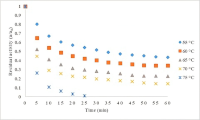
Enzymes derived from insects are increasingly recognized as promising alternatives to conventional microbial or plant-derived enzymes, owing to their adaptation to diverse ecological niches and their potential for unique biochemical properties. Among these, glycosidases play a central role in biomass conversion and related industrial processes, where stability under varying environmental conditions is essential. In this study, we investigated the thermal stability and inactivation kinetics of two insect-derived glycosidases, β-glucosidase (Rpbglu) and β-galactosidase (Rpbgal), isolated from the digestive tract of Rhynchophorus palmarum larvae. The primary objective was to evaluate their kinetic and thermodynamic behaviors during heat treatment using the Arrhenius model, to explore their potential for industrial and biotechnological applications. Experimental results demonstrated that both enzymes exhibited a progressive loss of activity in a temperature- and time-dependent manner, following first-order kinetics. Inactivation rate constants (k) increased with rising temperatures. The calculated activation energies (Ea) were 62.78 kJ·mol⁻¹ for β-glucosidase and 54.45 kJ·mol⁻¹ for β-galactosidase. Thermodynamic analyses revealed average activation enthalpies (ΔH#) of 60.01 and 51.64 kJ·mol⁻¹, respectively, and positive Gibbs free energies of activation (ΔG#), indicating that inactivation is a non-spontaneous process requiring external energy input. The negative activation entropies (ΔS#) further suggested a transition to a more ordered molecular state during inactivation. These findings highlight the notable thermal resilience of insect-derived glycosidases and provide fundamental insights into their kinetic properties. Overall, this study underscores their suitability as potential candidates for future biotechnological and industrial applications, particularly in sectors where catalytic efficiency and stability under heat stress are critical.
References
1. Jesionowski T, Zdarta J, Krajewska B. Enzyme immobilization by adsorption: a review. Adsorption 2014; 20(5-6):801–821.
2. Soares IA, Flores AC, Zanettin L, Pin HK, Mendonça MM, Barcelos RP, Trevisol LR, Carvlho RD, Schauren D, Rocha CLMSC, Baroni S. Identification of the amylolytic potential of mutant strains of the filamentous fungi Aspergillus nidulans. Ciênc. Tecnol. Aliment., Campinas 2010; 30(3):700–705.
3. Damin B, Kovalski FC, Fischer J, Piccin JS, Dettmer A. Challenges and perspectives of the β-galactosidase enzyme. Appl Microbiol Biotechnol. 2021; 105(13):5281–5298.
4. Gonçalves MCP, Kieckbusch TG, Perna RF, Fujimoto JT, Morales SAV, Romanelli JP. Trends on enzyme immobilization researches based on bibliometric analysis. Process Biochem. 2019; 76:95–110.
5. Wolf M, Gasparin BC, Paulino AT. Hydrolysis of lactose using β-d-galactosidase immobilized in a modified Arabic gum-based hydrogel for the production of lactose-free/low-lactose milk. Int J Biol Macromol. 2018; 115:157–164.
6. Raveendran S, Parameswaran B, Ummalyma SB, Abraham A, Mathew AK, Madhavan A, Sharrel R, Ashok P. Applications of Microbial Enzymes in Food Industry. Food Technol Biotechnol. 2018; 56(1):16–30.
7. Anisha GS. β-Galactosidases. In: Current Developments in Biotechnol and Bioeng. Elsevier; 2017. p. 395–421.
8. Profeta GS, Pereira JAS, Costa SG, Azambuja P, Garcia ES, Moraes CS, Genta FA. Standardization of a Continuous Assay for Glycosidases and Its Use for Screening Insect Gut Samples at Individual and Populational Levels. Front Physiol. 2017; 8:308:1-12.
9. Yang J, Gao R, Zhou Y, Anankanbil S, Li J, Xie G, Zheng G. β-Glucosidase from Thermotoga naphthophila RKU-10 for exclusive synthesis of galactotrisaccharides: Kinetics and thermodynamics insight into reaction mechanism. Food Chem. 2018; 240:422–429.
10. Zerva A, Koutroufini E, Kostopoulou I, Detsi A, Topakas E. A novel thermophilic laccase-like multicopper oxidase from Thermothelomyces thermophila and its application in the oxidative cyclization of 2',3,4-trihydroxychalcone. N Biotechnol. 2019; 49:10–18.
11. Zhou Y, Szaro NA, Atalah J, Espina G, Blamey JM, Ramasamy RP. Electro-Kinetic Study of Oxygen Reduction Reaction Catalyzed by Thermophilic Laccase. J. Electrochem. Soc. 2018; 165(10):H652-H657.
12. Ishibashi Y. Functions and applications of glycolipid-hydrolyzing microbial glycosidases. Biosci Biotechnol Biochem. 2022; 86(8):974–984.
13. Koffi GY, Konan KH, J. Kouadio NEJP. Purification and biochemical characterization of beta-glucosidase from cockroach, Periplaneta americana. J of Animal & Plant Sci. 2012; 13(2):1747–1757.
14. Yapi AYD, Gnakri D, Niamké LS, Kouamé LP. Purification and biochemical characterization of a specific beta-glucosidase from the digestive fluid of larvae of the palm weevil, Rhynchophorus palmarum. J of insect sci. 2009; 9(4):1–13.
15. Yapi AYD, Niamké LS, Kouamé LP. Biochemical characterization of a strictly specific beta-galactosidase from the digestive juice of the palm weevil Rhynchophorus palmarum larvae. Entomol Sci. 2007; 10(4): 343–352. Available from: URL: http://arxiv.org/pdf/2007.00232v2.
16. Garbin AP, Garcia NFL, Cavalheiro GF, Silvestre MA, Rodrigues A, Paz MF, Gustavo GF, Rodrigo SRL. β-glucosidase from thermophilic fungus Thermoascus crustaceus: production and industrial potential. An Acad Bras Cienc. 2021; 93(1):e20191349:1-12.
17. Chen A, Wang D, Ji R, Li J, Gu S, Tang R, Ji C. Structural and Catalytic Characterization of TsBGL, a β-Glucosidase From Thermofilum sp. ex4484_79. Front Microbiol. 2021; 12:723678:1-13.
18. Zhang D, Allen AB, Lax AR. Functional analyses of the digestive β-glucosidase of Formosan subterranean termites (Coptotermes formosanus). J Insect Physiol. 2012; 58(1):205–210.
19. European and Mediterranean Plant Protection Organization. Rhynchophorus palmarum. EPPO Bull. 2005; 35:468–471.
20. European and Mediterranean Plant Protection Organization. Rhynchophorus ferrugineus and Rhynchophorus palmarum. EPPO Bull. 2007:571–579.
21. Tchibozo S, Paoletti MG, Huis AV. Notes on edible insects of South Benin: A source of protein. Ecol of Food and Nutr. 2005; 36:245–250.
22. Bhatia Y, Mishra S, Bisaria VS. Microbial beta-glucosidases: cloning, properties, and applications. Crit Rev Biotechnol. 2002; 22(4):375–407.
23. Morant AV, Jørgensen K, Jørgensen C, Paquette SM, Sánchez-Pérez R, Møller BL, Bak S. beta-Glucosidases as detonators of plant chemical defense. Phytochem. 2008; 69(9):1795–1813.
24. Ketudat CJR, Esen A. β-Glucosidases. Cell Mol Life Sci. 2010; 67(20):3389–3405.
25. Yeoman CJ, Han Y, Dodd D, Schroeder CM, Mackie RI, Cann IKO. Thermostable enzymes as biocatalysts in the biofuel industry. Adv Appl Microbiol. 2010; 70:1–55.
26. Li D, Li X, Dang W, Tran PL, Park S-H, Oh B-C, Hong WS, Lee JS, Park KH. Characterization and application of an acidophilic and thermostable β-glucosidase from Thermofilum pendens. J Biosci Bioeng. 2013; 115(5):490–496.
27. Sawant S, Adlakha N, Odaneth AA, Chandrayan SK, Yazdani SS, Lali A. Role of N166 residue in β–glucosidase catalysis and glucose tolerance. Journal of Applied Biotechnol & Bioeng. 2019; 6(3):142–148.
28. Mostafa S, El Naby A, Zidan EW. Activity Level of Lactate Dehydrogenase and β-Glucosidase Enzymes in the Honeybee Colonies, (Apis Mellifera L.) with Different Feeding. Inter J of Agri Technol. 2014; 10(2):483–491.
29. Jonathan Woodward. Fungal and other glucosidases their properties and applications. Enzyme Microb. Technol. 1982; 4:73–79.
30. Kara HE, Turan Y, Er A, Acar M, Tümay S, Sinan S. Purification and characterization of β-glucosidase from greater wax moth Galleria mellonella L. (Lepidoptera: Pyralidae). Arch Insect Biochem Physiol. 2014; 86(4):209–219.
31. Singh G, Verma AK, Kumar V. Catalytic properties, functional attributes and industrial applications of β-glucosidases. 3 Biotech. 2016; 6(1):3:2-14.
32. Gunata Z, Vailier MJ, Sapis JC, Baumes R and Bayonove C. Enzymatic synthesis of monoterpenyl β-D-glucosides by various β-glucosidases. Enzyme Microb. Technol. 1994; 6:1055–1058.
33. Kang Y, Wei B, Guo D, Zheng S. Production of Alkyl Polyglucoside Using Pichia pastoris GS115 Displaying Aspergillus aculeatus β-Glucosidase I. In: Zhang T-C, Nakajima M, editors. Advances in Applied Biotechnology. Berlin, Heidelberg: Sprin Berl Heid. 2015. p. 417–426.
34. Frank M, Fisher JR. The Properties and Specificity of a β-Glucosidase from Blaberus craniifer. Mar Biol Lab. 1964; 126(2):220–234.
35. Kouadio NEJP, Kouassi KH, Kouakou MD, Dué AE, Kouamé KP. Insect digestive glycosidases: strategies of purification, biochemical properties and potential applications, a review. Int J of Entomol Res. 2016; 4(2):67–86.
36. Andrades D, Graebin NG, Ayub MA, Fernandez-Lafuente R, Rodrigues RC. Physico-chemical properties, kinetic parameters, and glucose inhibition of several beta-glucosidases for industrial applications. Proc Biochem. 2019; 78:82–90.
37. Panesar PS, Kumari S, Panesar R. Potential Applications of Immobilized β-Galactosidase in Food Processing Industries. Enzyme Res. 2010; 2010:1-16.
38. Souza CJ, Garcia-Rojas EE, Favaro-Trindade CS. Lactase (β-galactosidase) immobilization by complex formation: Impact of biopolymers on enzyme activity. Food Hydrocol. 2018; 83:88–96.
39. Daniel RM, Danson MJ. Temperature and the catalytic activity of enzymes: a fresh understanding. FEBS Lett 2013; 587(17):2738–2743.
40. Kambiré SM, Gnanwa MJ, Boa D, Kouadio NEJP, Kouamé LP. Modeling of enzymatic activity of free β-glucosidase from palm weevil, Rhynchophorus palmarum Linn. (Coleoptera: Curculionidae) larvae: Effects of pH and temperature. Biophys Chem. 2021; 276:1-13.
41. Kambiré SM, Gnanwa MJ, Boa D, Kouadio NEJP, Kouamé LP. Modeling of the thermal behaviour of free β-galactosidase from palm weevil, Rhynchophorus palmarum Linn. (Coleoptera: Curculionidae) larvae using Equilibrium model. Int. J. Bio. Chem. Sci. 2022; 16(4):1765–1774.
42. Onosakponome I, Awhin PE, Orhonigbe IO, Okorodudu OE. Thermodynamics and Thermal Inactivation of Endo-β-1,4-Glucanase Produced from Aspergillus niger. Trop J Nat Prod Res. 2024; 8(12): 9664-9669 https://doi.org/10.26538/tjnpr/v8i12.46.
43. Nsude CA, Ezike TC, Ezugwu AL, Eje OE, Onwurah INE, Chilaka FC. Kinetics and Thermodynamic Properties of Pectinase Obtained from Trichoderma longibrachiatum MT321074. Trop J Nat Prod Res. 2022; 6(12):2063-2072. http://www.doi.org/10.26538/tjnpr/v6i12.28
44. Sočan J, Purg M, Åqvist J. Computer simulations explain the anomalous temperature optimum in a cold-adapted enzyme. Natur Com. 2020; 11(1): 1-11.
45. Klein MP, Sant’Ana V, Hertz PF, Rodrigues RC, Ninow JL. Kinetics and Thermodynamics of Thermal Inactivation of β-Galactosidase from Aspergillus oryzae. Braz. arch. biol. technol. 2018; 61: e18160489 : 1-12.
46. Byeon GM, Lee KS, Gui ZZ, Kim I, Kang PD, Lee SM, Sohon HD, Jin BR. A digestive beta-glucosidase from the silkworm, Bombyx mori: cDNA cloning, expression and enzymatic characterization. Comp Biochem Physiol. 2005; 141(4):418–427.
47. Zhu Q, Huang Y, Yang Z, Wu X, Zhu Q, Zheng H, Zhu D, Lv Z, Yin Y. A Recombinant Thermophilic and Glucose-Tolerant GH1 β-Glucosidase Derived from Hehua Hot Spring. Molecules 2024; 29: 1017: 1-15. https://doi.org/10.3390/molecules29051017.
48. Daroit DJ, Sant'anna V, Brandelli A. Kinetic stability modelling of keratinolytic protease P45: influence of temperature and metal ions. Appl Biochem Biotechnol. 2011; 165(7-8):1740-1753.
49. Binaté S, N’dri D, TOKA M, Kouamé LP. Purification and characterisation of two beta-glucosidases from termite workers Macrotermes bellicosus (Termitidae: Macrotermitinae). J of Appl Biosci. 2008; 10:461–470.
50. Ya KC, Koné FMT, Gnangui NS, Dabonné S, Kouamé LP. A Beta-glucosidase with Beta-xylosidase Activity from the Digestive Juice of the Land Crab Cardisoma armatum. Asian J of Appl Sci. 2014; 2(4):414–426.
51. Otsuka FAM, Chagas RS, Almeida VM, Marana SR. Homodimerization of a glycoside hydrolase family GH1 β-glucosidase suggests distinct activity of enzyme different states. Protein Sci. 2020; 29(9):1879–1889.
52. Ferreira C, Terra WR. Physical and kinetic properties of a plasma-membrane-bound β-D-glucosidase (cellobiase) from midgut cells of an insect (Rhynchosciara americana larva). Biochem. J. 1983; 213:43–51.
53. Shimada S, Kamada A, Asano S. The cocoon trehalase of the silkworm, Bombyx mori. Insect Biochem. 1979; 10:49–52.
54. Glekas PD, Kalantzi S, Dalios A, Hatzinikolaou DG, Mamma D. Biochemical and Thermodynamic Studies on a Novel Thermotolerant GH10 Xylanase from Bacillus safensis. Biomolecules 2022; 12(6): 1-17.
55. Jacob AG, Wahab RA, Misson M. Operational Stability, Regenerability, and Thermodynamics Studies on Biogenic Silica/Magnetite/Graphene Oxide Nanocomposite-Activated Candida rugosa Lipase. Polymers (Basel) 2021; 13(21): 1-25.
56. Ustok FI, Tari C, Harsa S. Biochemical and thermal properties of β-galactosidase enzymes produced by artisanal yoghurt cultures. Food Chem. 2010; 119(3):1114–1120.
57. Bian J, Tan P, Nie T, Hong L, Yang G‐Y. Efficient enzyme stabilization by combining multiple mutations using the protein language model. mLife. 2024;3:492–504. https://doi.org/10.1002/mlf2.12151.
58. Huang Y-Y, Zhu D, Yang L-Q, Ortúzar M, Yang Z-F, Lv Z-H, Xie K-Q, Jiang H-C, Li W-J, Yin Y-R. Characterization, thermostable mechanism, and molecular docking of a novel glucose-tolerant β-glucosidase/β-galactosidase from the GH1 family isolated from Rehai hot spring. Front Microbiol. 2025; 16:1559242: 1-13. doi: 10.3389/fmicb.2025.1559242.
Published
Issue
Section
License
Copyright (c) 2025 Tropical Journal of Natural Product Research

This work is licensed under a Creative Commons Attribution-NonCommercial-NoDerivatives 4.0 International License.