


In vitro Cytoprotective Effects of Pluchea indica L. Leaf Extract on Vero Cells against Oxidative Stress: A Comparative Study of Preventive and Curative Treatments
Article Sidebar
Main Article Content
Abstract
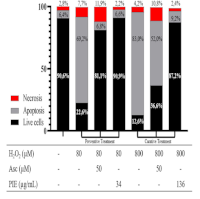
Pluchea indica leaf extract (PIE) has shown promise as an anti-aging agent by extending the lifespan of Saccharomyces cerevisiae. This study investigated the cytoprotective effects of P. indica in Vero cells, using cells divided into preventive and curative treatment groups. In the preventive group, PIE at concentrations of 136, 68, and 34 µg/mL was administered before the addition of 40 µM or 80 µM H₂O₂. In the curative group, the same PIE concentrations were given after the addition of 400 µM or 800 µM H₂O₂. Assays were conducted to evaluate cell viability, the production of reactive oxygen species (ROS), apoptosis, and caspase-3 activity. In the preventive treatment, H₂O₂ increased ROS formation by up to 70%, while PIE and ascorbic acid reduced ROS levels to 26.8% and 38%, respectively. In the curative treatment, H₂O₂ increased ROS production by 89.1%, with PIE and ascorbic acid reducing ROS levels by 36.6% and 52.2%, respectively. The percentages of cell death, apoptosis, and caspase-3 activity measured in cells under H₂O₂ stress and those treated with H₂O₂ combined with ascorbic acid and PIE showed consistent results, indicating a trend from highest to lowest compared to the control group. Notably, PIE demonstrated superior efficacy in maintaining cell viability compared to ascorbic acid. In conclusion, PIE exhibits cytoprotective properties in Vero cells, effectively mitigating oxidative stress in preventive treatments at lower concentrations and requiring higher concentrations for optimal repair in curative treatments.
Downloads
Article Details
Section

This work is licensed under a Creative Commons Attribution-NonCommercial-NoDerivatives 4.0 International License.
How to Cite
References
1.Reddy VP. Oxidative Stress in Health and Disease. Biomedicines. 2023; 11(11): 2925, 1 - 17. doi: 10.3390/biomedicines11112925.
2.Pizzino G, Irrera N, Cucinotta M, Pallio G, Mannino F, Arcoraci V, Squadrito F, Altavilla D, Bitto A. Oxidative Stress: Harms and benefits for human health. Oxid Med Cell Longev. 2017; 2017:8416763, 1 - 13. doi: 10.1155/2017/8416763
3.Trojahn C, Dobos G, Lichterfeld A, Blume-Peytavi U, Kottner J. Characterizing facial skin ageing in humans: disentangling extrinsic from intrinsic biological phenomena. BioMed Res Int. 2015; 2015:318586, 1 - 9. doi: 10.1155/2015/318586
4.Pillai S, Oresajo C, Hayward J. Ultraviolet radiation and skin aging: roles of reactive oxygen species, inflammation and protease activation, and strategies for prevention of inflammation-induced matrix degradation - a review. Int J Cosmet Sci. 2005; 27(1):17–34. doi: 10.1111/j.1467-2494.2004.00241.x
5.Qin D, Lee WH, Gao Z, Zhang W, Peng M, Sun T, Gao Y. Protective effects of antioxidin-RL from Odorrana livida against ultraviolet B-irradiated skin photoaging. Peptides. 2018; 101:124–134. doi: 10.1016/j.peptides.2018.01.009
6.Fernando IPS, Kirindage KGIS, Jayasinghe AMK, Han EJ, Dias MKHM, Kang KP, Moon SI, Shin TS, Ma A, Jung K, Ahn G. Makino & Shibata Abate Hydrogen Peroxide-Induced Oxidative Stress and Apoptosis in Kidney Epithelial Cells. Antioxid. 2022; 11(5):1013, 1 - 14. doi: 10.3390/antiox11051013
7.Kirindage KGIS, Fernando IPS, Jayasinghe AMK, Han EJ, Dias MKHM, Kang KP, Moon SI, Shin TS, Ma A, Ahn G. Moringa oleifera hot water extract protects vero cells from hydrogen peroxide-induced oxidative stress by regulating mitochondria-mediated apoptotic pathway and Nrf2/HO-1 signaling. Foods. 2022; 11(3):420, 1 – 16. doi: 10.3390/foods11030420
8.Lee HG, Jayawardena TU, Liyanage NM, Song KM, Choi YS, Jeon YJ, Kang MC. Antioxidant potential of low molecular weight fucoidans from Sargassum autumnale against H2O2-induced oxidative stress in vitro and in zebrafish models based on molecular weight changes. Food Chem. 2022; 384:132591. doi: 10.1016/j.foodchem.2022.132591
9.Dare RG, Nakamura CV, Ximenes VF, Lautenschlager SOS. Tannic acid, a promising anti-photoaging agent: Evidences of its antioxidant and anti-wrinkle potentials, and its ability to prevent photodamage and MMP-1 expression in L929 fibroblasts exposed to UVB. Free Radic Biol Med. 2020; 160:342–355. doi: 10.1016/j.freeradbiomed.2020.08.019
10.Lobo V, Patil A, Phatak A, Chandra N. Free radicals, antioxidants and functional foods: Impact on human health. Pharmacogn Rev. 2010 Jul;4(8):118–126. doi: 10.4103/0973-7847.70902
11.Retnaningtyas Y, Dewi N, Kristiningrum N, Kuswandi B. Antioxidant activity and H2O2 sensing ability of silver nanoparticles synthesized using Solanum melongena L. peel extract. Trop J Nat Prod Res. 2025; 9(6):2587–2594. doi: 10.26538/tjnpr/v9i6.34
12.Perdani L, Azasi NM, Sofyantoro F, Nugroho RA, Ismail NIM, Tunjung WAS. Analysis of anti-aging activity of Chinese perfume (Aglaia odorata) and Indian camphorweed (Pluchea indica) leaves using Saccharomyces cerevisiae model system. J Res Pharm. 2025; 29(1):396-406. doi: 10.29228/jrp.2022.00
13.Vongsak B, Kongkiatpaiboon S, Jaisamut S, Konsap K. Comparison of active constituents, antioxidant capacity, and α-glucosidase inhibition in Pluchea indica leaf extracts at different maturity stages. Food Biosci. 2018; 25:68–73. doi: 10.1016/j.fbio.2018.08.006
14.Cho JJ, Cho CL, Kao CL, Chen CM, Tseng CN, Lee YZ, Liao LJ, Hong YR. Crude aqueous extracts of Pluchea indica (L.) Less. inhibit proliferation and migration of cancer cells through induction of P53-dependent cell death. BMC Complement Altern Med. 2012; 12:265, 1 - 11. doi: 10.1186/1472-6882-12-265
15.Fitriansyah MI, Indradi RB. Review: Phytochemical Profile and Pharmacological Activities of Beluntas (Pluchea indica L.). Farmaka. 2018; 16(2):337-346. Retrieved from https://jurnal.unpad.ac.id/farmaka/article/view/17554
16.Kiyoshima T, Enoki N, Kobayashi I, Sakai T, Nagata K, Wada H, Fujiwara H, Ookuma Y, Sakai H. Oxidative stress caused by a low concentration of hydrogen peroxide induces senescence-like changes in mouse gingival fibroblasts. Int J Mol Med. 2012; 30(5):1007–1012. doi: 10.3892/ijmm.2012.1102
17.Wang L, Jayawardena TU, Yang HW, Lee HG, Kang MC, Sanjeewa KKA, Oh JY, Jeon YJ. Isolation, characterization, and antioxidant activity evaluation of a fucoidan from an enzymatic digest of the edible seaweed, Hizikia fusiforme. Antioxidants. 2020; 9(5):363,1 - 14. doi: 10.3390/antiox9050363
18.Haryanti S, Budiarti M, Farida S, Dewi APK, Supriyati N, Jokopriyambodo W, Wahyono S, Widowati L. The palm oil-based chlorophyll removal and the evaluation of antiaging properties on Centella asiatica ethanolic extract. IOP Conf Ser Earth Environ Sci. 2024; 1312(1):012041. doi: 10.1088/1755-1315/1312/1/012041
19.Reang J, Sharma PC, Thakur VK, Majeed J. Understanding the therapeutic potential of ascorbic acid in the battle to overcome cancer. Biomolecules. 2021; 11(8):1130, 1 - 24. doi: 10.3390/biom11081130
20.Kaur G, Dufour JM. Cell lines: Valuable tools or useless artifacts. Spermatogenesis. 2012; 2(1):1–5. doi: 10.4161/spmg.19885
21.Borges GDSC, Gonzaga LV, Jardini FA, Mancini Filho J, Heller M, Micke G, Costa ACO, Fett R. Protective effect of Euterpe edulis M. on vero cell culture and antioxidant evaluation based on phenolic composition using HPLC−ESI-MS/MS. Food Res Int. 2013; 51(1):363–369. doi: 10.1016/j.foodres.2012.12.035
22.Ammerman NC, Beier-Sexton M, Azad AF. Growth and maintenance of Vero cell lines. Curr Protoc Microbiol. 2008; 11(1): A-4E. doi: 10.1002/9780471729259.mca04es11
23.Xiang J, Wan C, Guo R, Guo D. Is hydrogen peroxide a suitable apoptosis inducer for all cell types? BioMed Res Int. 2016; 2016:7343965, 1 - 6. doi: 10.1155/2016/7343965
24.Hajam YA, Rani R, Ganie SY, Sheikh TA, Javaid D, Qadri SS, Pramodh S, Alsulimani A, Alkhanani MF, Harakeh S, Hussain A. Oxidative stress in human pathology and aging: molecular mechanisms and perspectives. Cells. 2022; 11(3):552, 1 - 27. doi: 10.3390/cells11030552
25.Hong Y, Boiti A, Vallone D, Foulkes NS. Reactive oxygen species signaling and oxidative stress: Transcriptional regulation and evolution. Antioxidants. 2024; 13(3):312, 1 - 24. doi: 10.3390/antiox13030312
26.Ali MAM, Kandasamy AD, Fan X, Schulz R. Hydrogen peroxide-induced necrotic cell death in cardiomyocytes is independent of matrix metalloproteinase-2. Toxicol Vitro Int J Publ Assoc BIBRA. 2013; 27(6):1686–1692. doi: 10.1016/j.tiv.2013.04.013.
27.Muchtaridi M, Az-Zahra F, Wongso H, Setyawati LU, Novitasari D, Ikram EHK. Molecular mechanism of natural food antioxidants to regulate ros in treating cancer: A review. Antioxidants. 2024; 13(2):207, 1 - 18. doi: 10.3390/antiox13020207
28.Ruan J, Li Z, Yan J, Huang P, Yu H, Han L, Zhang Y, Wang T. Bioactive constituents from the aerial parts of Pluchea indica Less. Molecules. 2018; 23(9): 2104, 1 - 11. doi: 10.3390/molecules23092104
29.Widyawati PS, Wijaya CH, Hardjosworo PS, Sajuthi D. Volatile compounds of Pluchea indica Less and Ocimum basillicum Linn essential oil and potency as antioxidant. HAYATI J Biosci. 2013 Sep 1;20(3):117–126. doi: 10.4308/hjb.20.3.117
30.Pekkoh J, Phinyo K, Thurakit T, Lomakool S, Duangjan K, Ruangrit K, Pumas C, Jiranusornkul S, Yooin W, Cheirsilp B, Pathom-Aree W. Lipid profile, antioxidant and antihypertensive activity, and computational molecular docking of diatom fatty acids as ACE inhibitors. Antioxidants. 2022. 11(2); 186, 1 - 16. doi: 10.3390/antiox11020186
31.Alsawaf S, Alnuaimi F, Afzal S, Thomas RM, Chelakkot AL, Ramadan WS, Hodeify R, Matar R, Merheb M, Siddiqui SS, Vazhappilly CG. Plant flavonoids on oxidative stress-mediated kidney inflammation. Biology. 2022; 11(12):1717, 1 - 27. doi: 10.3390/biology11121717