Evaluation of the Antioxidant, Anxiolytic and Anti-Epileptogenic Effects of Vitex chrysocarpa Leaf
DOI:
https://doi.org/10.26538/tjnpr/v9i10.57Keywords:
Antioxidant, Anxiolytic, Anti-epileptogenic, Vitex chrysocarpa, 2,2, Azino-bis(3ethylbenzthiazoline-6-sulphonic acid)Abstract
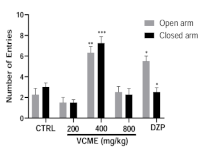
Vitex chrysocarpa is a medicinal plant widely used in traditional medicine across the native parts of tropical Africa for treatment of various health conditions including anxiety, epilepsy, oxidative stress, microbial infections and inflammation. This study aimed to investigate the antioxidant, anxiolytic and anti-epileptogenic activities of Vitex chrysocarpa leaf methanol extract using established models. The 2,2, azino-bis(3ethylbenzthiazoline-6-sulphonic acid) (ABTS) free radical scavenging activity, total flavonoid, total phenolic ferric reducing antioxidant power and total capacity assays was used to measure the antioxidant activity, while Lorke’s method was used to evaluate the oral acute toxicity (LD50) of the extract in mice. Elevated plus maze model was used to evaluate the anxiolytic activity while pentyleneterazole-induced seizure model was used to evaluate the anti-epileptogenic activity of the extract in mice. In the anxiolytic and anti-epileptogenic studies, graded doses of the extract (200 – 800 mg/kg p.o) were evaluated, while diazepam was served as positive control. Results from the study revealed that the LD50 of the extract in mice was greater than 5000 mg/kg. The extract demonstrated good antioxidant activity that has 47.28% inhibition at 400 µg/ mL in the ABTS assay. The extract also had significant (p ˂ 0.05) anxiolytic and anti-epileptogenic effects during the study. The study outcome thus shows that Vitex Chrysocarpa leaf extract had potent antioxidant, anxiolytic and anti-epileptogenic activities hence may serve as scientific justification for its use in ethnomedicine.
References
1.Enegide C, Ezike AC, Ameh SF, Ezenyi IC, Okhale SE, Akah PA. GC-MS Analysis, Anxiolytic and Anti-Epileptogenic Effects of Combretum nigricans Leaf Extract in Laboratory Animals. Advan Pharmacol Pharm, 2025:13(3), 368 - 376. DOI: 10.13189/app.2025.130308.
2.Bie F, Yan X, Xing J, Wang L, Xu Y, Wang Q, Qiao J, Rao Z. Rising global burden of anxiety disorders among adolescents and young adults: trends, risk factors, and the impact of socioeconomic disparities and COVID-19 from 1990 to 2021. Front Psychiatry. 2024;15:1489427.
3.Steimer T. The biology of fear- and anxiety-related behaviors’, Dialogues Clin Neurosci, 2002;4(3):231–249. doi: 10.31887/DCNS.2002.4.3/tsteimer.
4.Chakraborty S, Parayil R, Mishra S, Nongthomba U, Clement JP. Epilepsy Characteristics in Neurodevelopmental Disorders: Research from Patient Cohorts and Animal Models Focusing on Autism Spectrum Disorder. Int J Mol Sci 2022;23:10807. https://doi.org/10.3390/ijms231810807
5.Fiest KM, Sauro KM, Wiebe S, Patten SB, Kwon C, Jette N. Prevalence and incidence of epilepsy: A systematic review and meta-analysis of international studies Neurology. 2017;88(3):296-303. doi:10.1212/WNL.0000000000003509
6.Fabisiak T, Patel M. Crosstalk between neuroinflammation and oxidative stress in epilepsy. Front. Cell Dev. Biol. 2022;10:976953. doi: 10.3389/fcell.2022.976953
7.Löscher W, Klein P. The Pharmacology and Clinical Efficacy of Antiseizure Medications: From Bromide Salts to Cenobamate and Beyond. CNS Drugs 2021;35, 935–963. https://doi.org/10.1007/s40263-021-00827-8
8.Bindu J, Narendhirakannan R T. Role of medicinal plants in the management of diabetes mellitus: a review. Biotech. 2019;9(1):4. doi:10.1007/s13205-018-1528-0
9.Kamal N, Mio-Asni NS, Rozlan INA, Azmi AHM, Mazlan NW, Edrada-Ebel RA. Traditional Medicinal Uses, Phytochemistry, Biological Properties, and Health Applications of Vitex sp. Plants (Basel). 2022;11(15):1944.doi:10.3390/plants11151944
10.Handa SS, Khanuja SPS, Longo G, Rakesh DD. Extraction technologies for medicinal and aromatic plants. International Centre for Science and High Technology ICS UNIDO, Trieste, Italy; 2008.
11.Evans WC. Trease and Evans Pharmacognosy, (14th ed), WB Saunders Company Limited, London;2005:357-358.
12.Re R, Pellegrini N, Proteggente A, Pannala A, Yang M, Rice-Evans C. Antioxidant activity applying an improved ABTS radical cation decolorization assay. Free Radic Biol Med. 1999;26(9-10):1231-1237. doi:10.1016/s0891-5849(98)00315-3
13.Ebrahimzadeh MA, Hosseinimehr SJ, Hamidinia A, Jafari M. Antioxidant and free radical scavenging activity of Feijoa sellowiana fruits peel and leaves. Pharmacol. 2008;1:7-14.
14.Dewanto V, Wu X, Adom K, Liu RH. Thermal processing enhances the nutritional value of tomatoes by increasing total antioxidant activity. J Agric Food Chem. 2002;50:3010-3014.
15.Benzie IF, Strain JJ. The ferric reducing ability of plasma (FRAP) as a measure of “antioxidant power”: the FRAP assay. Anal Biochem. 1996;239:70-76.
16.Prieto P, Pineda M, Aguilar M. Spectrophotometric quantitation of antioxidant capacity through the formation of a phospho molybdenum complex: specific application to the determination of vitamin E. Anal Biochem. 1999;269:337-341.
17.NIH. Guide for the care and use of Laboratory animal (Revised). Washington: NIH Publication; 1985:83-123.
18.Lorke D. A new approach to practical acute toxicity testing. Arch Toxicol. 1983;54(4), 275–287. https://doi.org/10.1007/BF01234480
19.Enegide C, Arome D, Ameh FS. A new method for determining acute toxicity in animal models. Toxicol Int. 2013;(3), 224–226. https://doi.org/10.4103/0971-6580.121674
20.Yuskaitis CJ, Rossitto LA, Groff KJ, Dhamne SC, Zhang B, Lalani LK, Singh AK, Rotenberg A, Sahin M. Factors influencing the acute pentylenetetrazole-induced seizure paradigm and a literature review. Annal Clin Trans Neurol 2021;1388-1397. doi: 10.1002/acn3.51375
21.Carobrez AP, Bertoglio LJ. Ethological and temporal analyses of anxiety-like behavior: The elevated plus-maze model 20 years on. Neurosci and Biobehavior Rev. 2005;29(8), 1193-1205.
22.Alakrishnan R, Azam S, Cho DY, Su-Kim I, Choi DK. Natural Phytochemicals as Novel Therapeutic Strategies to Prevent and Treat Parkinson's Disease: Current Knowledge and Future Perspectives. Oxid Med cell longev 2021;6680935. https://doi.org/10.1155/2021/6680935
23.Tungmunnithum D, Thongboonyou A, Pholboon A, Yangsabai A. Flavonoids and Other Phenolic Compounds from Medicinal Plants for Pharmaceutical and Medical Aspects: An Overview. Med 2018;5(3), 93. https://doi.org/10.3390/medicines5030093
24.Corbett JR, Wright J, Baille AC. The Biochemical mode of action of pesticides. 2nd Ed. Academic Press, London and New York, 1984.
25.Kennedy GL, Ferenz RLJ, Burgess BA. Estimation of acute toxicity in rats by determination of the approximate lethal dose rather than LD50. J Applied Toxicol, 1986;6:145-148.
26.Syahmi, ARM, Vijayarathna S, Sasidharan S, Latha L, Kwan YP, Lau YL, Shin LN, Chen Y. Acute oral toxicity and brine shrimp lethality of Elaeis guineensis Jacq., (Oil Palm leaf) methanol extract. Molecul 2010;15, 8111-8121.
27.Phootha N, Yongparnichkul N, Fang Z, Gan R, Zhang P. Plants and phytochemicals potentials in tackling anxiety: A systematic review, Phytomed Plus 2022;2(4):100375. https://doi.org/10.1016/j.phyplu.2022.100375.
28.Waris A, Ullah A, Asim M, Ullah R, Rajdoula MR, Bello ST, Alhumaydhi FA. Phytotherapeutic options for the treatment of epilepsy: pharmacology, targets, and mechanism of action. Front Pharmacol 2024;15, 1403232. https://doi.org/10.3389/fphar.2024.1403232
Published
Issue
Section
License
Copyright (c) 2025 Tropical Journal of Natural Product Research

This work is licensed under a Creative Commons Attribution-NonCommercial-NoDerivatives 4.0 International License.