


Histological Effects of Kepok Banana (Musa paradisiaca L.) Heart Extract on the Kidneys and Liver of Mice
Article Sidebar
Main Article Content
Abstract
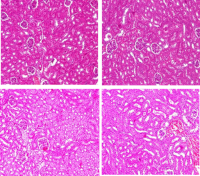
Kepok banana (Musa paradisiaca L.) heart is rich in secondary metabolites and has found wide applications in traditional medicine. This study aimed to assess the safety of Kepok banana heart extract on the kidney and liver histology in male albino mice. Musa paradisiaca heart extract was obtained by maceration in 70% ethanol, and the extract was formulated into a suspension. Thirty-six male albino mice were divided into four groups: a control group and three treatment groups which received oral administration of the extract for 7, 14, and 21 days at doses of 200, 400, and 800 mg/kg body weight (bw). Liver and kidney samples were taken for histological examination. The observed parameter was histological tissue damage in the kidneys and liver. The outcome indicated that the administration of Musa paradisiaca heart extract at doses of 200 - 800 mg/kg bw did not cause significant damage across all time points. However, at 800 mg/kg bw, histological changes, such as hyperemia (day 7) and inflammatory cell infiltration (days 14 and 21), were observed. On day 14, liver analysis revealed that the 200 and 400 mg/kg bw groups' hepatocytes and central vein architectures were normal. Mild periportal inflammatory infiltration was noted in the 800 mg/kg bw group. These findings suggest that Musa paradisiaca heart extract is relatively safe at doses of 200 - 400 mg/kg bw but may induce mild tissue alterations at 800 mg/kg bw. Further investigation is recommended to evaluate long-term toxicity and establish safety thresholds for potential therapeutic applications.
Downloads
Article Details
Section

This work is licensed under a Creative Commons Attribution-NonCommercial-NoDerivatives 4.0 International License.
How to Cite
References
1. Kemisetti D, Das R, Bhattacharya B. A Comprehensive Review on Musa paradisiaca Taxonomical, Morphological Classification and Its Pharmacological Activities. J Pharm Negat. 2022; 13(10):737-749.
2. Heryani S, Ningrum WM, Mukti AS, Rohmah S. Conservation of Local Resources: The Role of Kepok Banana Blossom in Supporting Breast Milk Production. Int Interdiscip J Cancer Care. 2024; 2(2):16-21.
3. Vilhena RO, Figueiredo ID, Baviera AM, Silva DB, Marson BM, Oliveira JA, Peccinini RG, Borges IK, Pontarolo R. Antidiabetic Activity of Musa x paradisiaca Extracts in Streptozotocin-Induced Diabetic Rats and Chemical Characterization by HPLC-DAD-MS. J Ethnopharmacol. 2020; 254:1-6.
4. Zaynab M, Fatima M, Abbas S, Sharif Y, Umair M, Zafar MH, Bahadar K. Role of Secondary Metabolites in Plant Defense Against Pathogens. Microb Pathogenesis. 2018; 124:198-202.
5. Mahmood A, Ngah N, Omar MN. Phytochemicals Constituent and Antioxidant Activities in Musa x paradisiaca Flower. Eur J Sci Res. 2011; 66(2):311–318.
6. Albert Z. Renal Physiology. J Interven Nephrol. 2022; 5(5):66–69.
7. Henry M. The Essential Role of Liver Functioning in Metabolism, Detoxification, and Overall Health: Insights from Modern Medicine. J Clin Gastroenterol Hepatol. 2024; 8(4):35.
8. Oliva AD, Avalos IH, Burnes JM, Hernandes AO, Mendoza AV, Rojas DM. The Importance of Animal Models in Biomedical Research: Current Insights and Applications. Animals (Basel). 2023; 13:1-24.
9. Dhipa S, Aldi Y, Husni E. Sub-Acute Toxicity of Banana (Musa Paradisiaca L.) Heart Extract on Haematological Parameters in Mice. Trop J Nat Prod Res. 2024; 8(9):8332 – 8335.
10. Solekha R, Puspaningsih NNT, Setiyowati PAI, Kusumanegara SBSM, Mujahid F, Purnobasuki H. The Effect In Vivo and In Silico Citronella Grass Extract (Cymbopogon nardus L.) on the Plasma ACE Inhibitory Activity and Antihypertensive Effect. Res J Pharm Technol. 2023; 16(10):4487-4492.
11. Dillasamola D, Aldi Y, Fakhri M, Diliarosta S, Oktomalio B, Noverial. Immnunomodulatory Effect Test from Moringa Leaf Extract (Moringa oleifera L.) with Carbon Cleareance Method in Male White Mice. Asian J Pharm Clin Res. 2018; 11(9):241-245.
12. Ahmed A, Al Tamimi DM, Isab AA, Alkhawajah AMM, Shawarby MA. Histological Changes in Kidney and Liver of Rats Due to Gold (III) Compound [Au(En)Cl2]Cl. Plos One. 2012; 7(12):1–11.
13. Azam FM, Fazila SHN, Fatin RA, Noordin MM, Yimer N. Histopathological Changes of Acetaminophen-Induced Liver Injury and Subsequent Liver Regeneration in BALB/C and ICR Mice. Vet World. 2019; 12:1682-1688.
14. Rosenberry R and Nelson MD. Reactive Hyperemia: A Review of Methods, Mechanisms, and Considerations. Am J Physiol Regul Integr Comp Physiol. 2020; 318(3):R605–R618.
15. Cheville NF. Introduction to Veterinary Pathology. The Iowa State University Press; 1999.
16. Özdemir S. Inflammation: Complexity and Significance of a Protective Mechanism. J Acute Dis. 2024; 13(1):3‑7.
17. Takeuchi O and Akira S. Pattern Recognition Receptors and Inflammation. Cell. 2010; 140:805–820.
18. Jabbour HN, Sales KJ, Catalano RD, Norman JE. Inflammatory Pathways in Female Reproductive Health and Disease. Reprod. 2009; 138:903–919. doi: 10.1530/REP-09-0247.
19. Green S, Dobrjansky A, Chiasson MA. Murine Tumor Necrosis-Inducing Factor: Purification and Effects on Myelomonocytic Leukemia Cells. J Natl Cancer Inst. 2012; 68(6):997–1003.
20. Sumadewi KT. Embryology, Anatomy and Physiology of the Liver: Review. Int J Clin Anal Pathol. 2023; 10(4):138-144.
21. Cunningham RP and Porat‑Shliom N. Liver Zonation–Revisiting Old Questions with New Technologies. Front Physiol. 2021; 12:1-17.
22. Brenner C, Galluzzi L, Kepp O, Kroemer G. Decoding Cell Death Signals in Liver Inflammation. J Hepatol. 2013; 59:583–594.
23. Yolanda S, Etriwati, Erwin, Masyitha D, Roslizawaty, Sayuti A. Histopathological of White Rat (Rattus norvegicus) Liver After Implantation of Metal Wire Material. J Immunol Vet Sci. 2022; 6(4):234-242.
24. Ravish G. Decoding Drug Toxicity: Histopathological Insights into Tissue Reactions and Mechanisms of Adverse Effects. J Interdiscip Histopathol. 2024; 12(1):1-2.