


Chronic Exposure to Various Propolis Extracts from North Sumatra Does Not Trigger Hepatic Inflammation and Autophagy Gene Expression in Wistar Rats
Article Sidebar
Main Article Content
Abstract
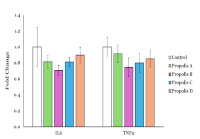
The liver has key roles in metabolism, detoxification, and immunity, making it prone to inflammation and autophagy disruption. Natural bioactive compounds, such as stingless bee propolis, have been studied for their potential protective effects on various organs, including the liver. The purpose of this work was to analyze the phytochemical compounds of different propolis types and their effects on inflammation (IL-6 and TNF-α) and autophagy (LC3 and p62) gene expression in the liver. Propolis was obtained from different regions of North Sumatra, Indonesia (Karo Regency, Langkat Regency, and Tapanuli Tengah Regency), produced by two stingless bee species: Geniotrigona thoracica (Propolis A, B, C) and Tetrigona apicalis (Propolis D). Twenty-five Wistar rats (12 weeks old) were divided into five groups: a control group and four treatment groups receiving Propolis A, B, C, and D, each at an approximate dose of 100 mg/kg/day. Propolis was administered daily via drinking water for six consecutive months. Phytochemical screenings were conducted, and inflammation and autophagy gene expressions were evaluated using real-time polymerase chain reaction (PCR). Different phytochemical compounds were found in the four different propolis types, with Propolis B showing the most abundant phenolics, tannins, flavonoids, triterpenoids, and saponins. No significant difference in IL-6 and TNF-α gene expression was found between groups. The study highlights that chronic exposure to various propolis types does not induce hepatic inflammation or autophagy-related gene expression in healthy Wistar rats, while also suggesting that bee species and regional origin may influence their phytochemical composition and bioactivity.
Downloads
Article Details
Section

This work is licensed under a Creative Commons Attribution-NonCommercial-NoDerivatives 4.0 International License.
How to Cite
References
1. Alamri ZZ. The role of liver in metabolism: an updated review with physiological emphasis. Int J Basic Clin Pharmacol. 2018; 7(11):2271–2276. Doi: 10.18203/2319-2003.ijbcp20184211.
2. Wu J, Duan C, Yang Y, Wang Z, Tan C, Han C, Hou X. Insights into the liver-eyes connections, from epidemiological, mechanical studies to clinical translation. J Transl Med. 2023; 21(1):712. Doi: 10.1186/s12967-023-04543-3.
3. Loomba R, Friedman SL, Shulman GI. Mechanisms and disease consequences of nonalcoholic fatty liver disease. Cell. 2021; 184(10):2537–2564. Doi: 10.1016/j.cell.2021.04.015.
4. Allameh A, Niayesh-Mehr R, Aliarab A, Sebastiani G, Pantopoulos K. Oxidative Stress in Liver Pathophysiology and Disease. Antioxidants (Basel). 2023; 12(9):1653. Doi: 10.3390/antiox12091653.
5. Bhargava P, Mahanta D, Kaul A, Ishida Y, Terao K, Wadhwa R, Kaul SC. Experimental Evidence for Therapeutic Potentials of Propolis. Nutrients. 2021; 13(8):252. Doi: 10.3390/nu13082528.
6. Sahlan M, Rizka Alia Hapsari N, Diah Pratami K, Cahya Khayrani A, Lischer K, Alhazmi A, Mohammedsaleh ZM, Shater AF, Saleh FM, Alsanie WF, Sayed S, Gaber A. Potential hepatoprotective effects of flavonoids contained in propolis from South Sulawesi against chemotherapy agents. Saudi J Biol Sci. 2021; 28(10):5461–5468. Doi: 10.1016/j.sjbs.2021.08.022.
7. Bhadauria M, Singh S, Kumar D, Nirala S. Hepatoprotective potential of propolis. IP Int J Compr Adv Pharmacol. 2023; 8(2):91–97. Doi: 10.18231/j.ijcaap.2023.016.
8. Hossain R, Quispe C, Khan RA, Saikat ASM, Ray P, Ongalbek D, Yeskaliyeva B, Jain D, Smeriglio A, Trombetta D, Kiani R, Kobarfard F, Mojgani N, Saffarian P, Ayatollahi SA, Sarkar C, Islam MT, Keriman D, Uçar A, Martorell M, Sureda A, Pintus G, Butnariu M, Sharifi-Rad J, Cho WC. Propolis: An update on its chemistry and pharmacological applications. Chin Med. 2022; 17(1):100. Doi: 10.1186/s13020-022-00651-2.
9. Cong NT, Van TTT, Hang NT, Diep VT, Hang NT, Bankova V, Popova M, Trusheva B, Phuong DTL, Thanh LN. Triterpenes and their Biological Activities from Propolis of Stingless Bee Tetrigonilla collina. Trop J Nat Prod Res. 2025; 9(7):3118–3126. Doi: 10.26538/tjnpr/v9i7.35.
10. Lesmana R, Tandi YYP, Megantara I, Rosdianto AM, Goenawan H, Christoper A, Gunadi JW, Radhiyanti PT, Zulhendri F. Propolis Extract Alters the Abundance of Bacteroides thetaiotaomicron and Faecalibacterium prausnitzii, and Ileum Mucosal Structure of Male Wistar Rats with High-Fat Diet. Trop J Nat Prod Res. 2024; 8(7):7650–7657. Doi: 10.26538/tjnpr/v8i7.4.
11. Megantara I, Murad C, Pahlevi F, Sylviana N, Goenawan H, Lesmana R. The Effect of Propolis Extract from Sumatra, Indonesia on Escherichia coli and IL-6 Gene Expression in Male Wistar Rats Fed with a High-Fat Diet. Trop J Nat Prod Res. 2024; 8(6):7350–7354. Doi: 10.26538/tjnpr/v8i6.3.
12. Yanti E, Kustiawan PM. Study Of Indonesian Stingless Bee Propolis Potential As Antioxidant: A Review. Jurnal Farmasi Sains dan Praktis. 2023; 9(3):261–269. Doi: 10.31603/pharmacy.v9i3.7105.
13. Pratami DK, Sahlan M, Bayu A, Putra MY, Ibrahim B, Siswadi, et al. Characteristics of Indonesian Stingless Bee Propolis and Study of Metabolomic Properties Based on Region and Species. Molecules. 2024; 29(17):4037. Doi: 10.3390/molecules29174037.
14. Woźniak M, Sip A, Mrówczyńska L, Broniarczyk J, Waśkiewicz A, Ratajczak I. Biological Activity and Chemical Composition of Propolis from Various Regions of Poland. Molecules. 2022; 28(1):141. Doi: 10.3390/molecules28010141.
15. Dezmirean DS, Paşca C, Moise AR, Bobiş O. Plant Sources Responsible for the Chemical Composition and Main Bioactive Properties of Poplar-Type Propolis. Plants (Basel). 2020; 10(1):22. Doi: 10.3390/plants10010022.
16. Shehata MG, Ahmad FT, Badr AN, Masry SH, El-Sohaimy SA. Chemical analysis, antioxidant, cytotoxic and antimicrobial properties of propolis from different geographic regions. Annals of Agricultural Sciences. 2020; 65(2):209–217. Doi: 10.1016/j.aoas.2020.12.001.
17. Kern L, Mittenbühler MJ, Vesting AJ, Ostermann AL, Wunderlich CM, Wunderlich FT. Obesity-Induced TNFα and IL-6 Signaling: The Missing Link between Obesity and Inflammation—Driven Liver and Colorectal Cancers. Cancers. 2019; 11(1):24. Doi: 10.3390/cancers11010024.
18. Pratim Das P and Medhi S. Role of inflammasomes and cytokines in immune dysfunction of liver cirrhosis. Cytokine. 2023; 170:156347. Doi: 10.1016/j.cyto.2023.156347.
19. Schmidt-Arras D and Rose-John S. IL-6 pathway in the liver: From physiopathology to therapy. J Hepatol. 2016; 64(6):1403–1415. Doi: 10.1016/j.jhep.2016.02.004.
20. Qian H, Chao X, Williams J, Fulte S, Li T, Yang L, Ding W. Autophagy in liver diseases: A review. Mol Aspects Med. 2021; 82:100973. Doi: 10.1016/j.mam.2021.100973.
21. Wu Y, Tan HWS, Lin JY, Shen HM, Wang H, Lu G. Molecular mechanisms of autophagy and implications in liver diseases. Liver Res. 2023; 7:56–70. Doi: 10.1016/j.livres.2023.02.002.
22. Maheshwaran L, Nadarajah L, Senadeera N, Ranaweera C, Chandana A, Pathirana R. Phytochemical Testing Methodologies and Principles for Preliminary Screening/ Qualitative Testing. Asian Plant Res J. 2024; 12(5):11–38. Doi: 10.9734/aprj/2024/v12i5267.
23. Rocha VM, Portela RW, Lacerda LE, Sokolonski AR, de Souza CO, dos Anjos JP, et al. Propolis from different Brazilian stingless bee species: phenolic composition and antimicrobial activity. Food Prod Process Nutr. 2024; 6:12. Doi: 10.1186/s43014-023-00195-4.
24. Herrera-López M, Richomme P, Peña-Rodríguez L, Calvo-Irabién L. Bee Species, Botanical Sources and the Chemical Composition of Propolis from Yucatan, Mexico. J Chem Ecol. 2023; 49(7–8):1–10. Doi: 10.1007/s10886-023-01429-y.
25. Kegode TM, Mokaya HO, Chogo SI, Noiset P, Vereecken NJ, Tamiru A, Subramanian S, Kiatoko N. Differences in the biochemical content and radical scavenging activity of propolis from different parts of a Meliponula ferruginea hive. R Soc Open Sci. 2023; 10(12):230241. Doi: 10.1098/rsos.230241.
26. Rozman AS, Hashim N, Maringgal B, Abdan K. A Comprehensive Review of Stingless Bee Products: Phytochemical Composition and Beneficial Properties of Honey, Propolis, and Pollen. Appl Sci. 2022; 12(13):6370. Doi: 10.3390/app12136370.
27. Mohammad SM, Mahmud-Ab-Rashid NK, Zawawi N. Stingless Bee-Collected Pollen (Bee Bread): Chemical and Microbiology Properties and Health Benefits. Molecules. 2021; 26(4):957. Doi: 10.3390/molecules26040957.
28. Idris L, Adli A, Yaacop N, Mohd Zohdi R. Phytochemical Screening and Antioxidant Activities of Geniotrigona thoracica Propolis Extracts Derived from Different Locations in Malaysia. Malays J Fundam Appl Sci. 2023; 19(6):1023–1032. Doi: 10.11113/mjfas.v19n6.3128.
29. Jusril Atiqah N, Mohd Suryati K, Abd Mutalib N, Mohd Badiazaman Awanis A. Chemical composition and pharmacological aspects of Malaysian stingless bee propolis: An up‑to‑date systematic review. Biomed Rep. 2025; 22(1):9. Doi: 10.3892/br.2024.1887.
30. Kustiawan PM, Luthfi M CFM, Dewi SR, Pratiwi J, Aisyiyah NM, Nugraha ASD, Setiawan IM. Phytochemical Analysis and Anti-Inflammatory Activity of the Combination of Trigona apicalis propolis Extract and Honey. Borneo J Pharm. 2023; 6(2):125–132. Doi: 10.33084/bjop.v6i2.4696.
31. Grassi G, Capasso G, Gambacorta E, Perna AM. Chemical and Functional Characterization of Propolis Collected from Different Areas of South Italy. Foods. 2023; 12(18):3481. Doi: 10.3390/foods12183481.
32. Rahayu M, Kalima T, Martgrita MM, Sembiring C, Simangunsong L, Elisabeth S, Munawaroh E, Astuti IP, Susiarti S, Oryzanti P, Sihotang VBL, Purwanto Y, Nikmatullah M. Ethnobotany and diversity of Citrus spp. (Rutaceae) as a source of “Kem-kem” traditional medicine used among the Karo sub-ethnic in North Sumatra, Indonesia. Heliyon. 2024; 10(9):e29721. Doi: 10.1016/j.heliyon.2024.e29721.
33. Drescher N, Klein A, Schmitt T, Leonhardt S. A clue on bee glue: New insight into the sources and factors driving resin intake in honeybees (Apis mellifera). PLoS One. 2019; 14(2):e0210594. Doi: 10.1371/journal.pone.0210594.
34. Shanahan M and Spivak M. Resin Use by Stingless Bees: A Review. Insects. 2021; 12(8):719. Doi: 10.3390/insects12080719.
35. Mohd-Yazid NA, Zin NBM, Pauzi N, Mohd KS. Preliminary Evaluation of Antioxidant and Cytotoxic Activity of Ethanolic Extract of Stingless Bees Propolis From Different Localities. J Agrobiotechnol. 2018; 9(1s):132–141.
36. Bava R, Puteo C, Lombardi R, Garcea G, Lupia C, Spano A, Liguori G, Palma E, Britti D, Castagna F. Antimicrobial Properties of Hive Products and Their Potential Applications in Human and Veterinary Medicine. Antibiotics (Basel). 2025; 14(4):172. Doi: 10.3390/antibiotics14020172.
37. Eshwar S and Suma B. Health from the Hive: Potential Uses of Propolis in General Health. Int J Clin Med. 2012; 3(3):159-162. Doi: 10.4236/ijcm.2012.33033.
38. Li J, Liu H, Liu X, Hao S, Zhang Z, Xuan H. Chinese Poplar Propolis Inhibits MDA‐MB‐231 Cell Proliferation in an Inflammatory Microenvironment by Targeting Enzymes of the Glycolytic Pathway. J Immunol Res. 2021; 2021:6641341. Doi: 10.1155/2021/6641341.
39. Lesmana R, Tandean S, Christoper A, Suwantika AA, Wathoni N, Abdulah R, Fearnley J, Bankova V, Zulhendri F. Propolis as an autophagy modulator in relation to its roles in redox balance and inflammation regulation. Biomed Pharmacother. 2024; 175:116745. Doi: 10.1016/j.biopha.2024.116745.