


Effects of Triticum aestivum L. and Triticum durum Desf. Bran Processing on Fiber Content and Consumer Acceptance of Bran-Containing Cookies
Article Sidebar
Main Article Content
Abstract
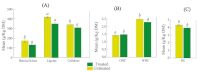
Triticum aestivum L. and Triticum durum Desf. bran is a by-product of milling with valuable dietary fiber content, yet its incorporation in food products often affects sensory acceptability. The present study aimed to determine how various processing techniques affect the amount of fiber in wheat bran and how these changes affect the overall quality, sensory qualities, and consumer acceptance of cookies made with bran. Untreated and cellulase-treated brans were incorporated into cookies to evaluate compositional changes and consumer acceptance. The results showed that soft wheat bran contained higher levels of cellulose (350 g/kg) and hemicellulose (270 g/kg) compared to durum wheat bran (300 g/kg and 230 g/kg, respectively), whereas durum bran had greater amounts of lignin (80 g/kg vs. 50 g/kg) and ash (120 g/kg vs. 90 g/kg). Enzymatic treatment reduced cellulose and hemicellulose contents to 324.5 g/kg and 150 g/kg in soft bran and to 280 g/kg and 125 g/kg in durum bran, respectively. Reducing sugar release increased more in treated durum bran (3.10 mg/g) than in soft bran (1.00 mg/g). Coarse bran retained more fibrous structures, while fine bran released more reducing sugars. No significant differences (p > 0.05) in water-holding or oil-holding capacity were observed across particle sizes. Sensory analysis slightly favoured cookies with coarse durum bran (taste: 15.7 ± 2.8; appearance: 14.6 ± 2.9), though not all differences were statistically significant. Demographic variables had a limited impact, though gender influenced appearance scores, and field of study affected taste ratings. The findings suggest that enzymatic treatment and optimal particle size can enhance the acceptability of bran-enriched products.
Downloads
Article Details
Section

This work is licensed under a Creative Commons Attribution-NonCommercial-NoDerivatives 4.0 International License.
How to Cite
References
1. Liu X, Ma Y, Zhang M, Chen Z, Wang Y, Liu J, Yu Y. Modification of wheat bran insoluble and soluble dietary fibers with snail enzyme. Food Sci Hum Wellness. 2021; 10(3):356–361. https://doi.org/10.1016/j.fshw.2021.02.027
2. Mato L, Damani Z, Osmanaj A, Topi D. Nutritional value and quality aspects of wheat produced and consumed in Albania. BIO Web Conf. 2024; 85:01059. https://doi.org/10.1051/bioconf/20248501059
3. Rossi D, Rossi S, Cinelli P, Seggiani M. Emerging opportunities in the valorization of wheat bran byproduct as additive in polymer composite materials. Mater Today Sustain. 2024; 27:100832. https://doi.org/10.1016/j.mtsust.2024.100832
4. Sztupecki W, Rhazi L, Depeint F, Aussenac T. Functional and nutritional characteristics of natural or modified wheat bran non-starch polysaccharides: A literature review. Foods. 2023; 12(14):2693. https://doi.org/10.3390/foods12142693
5. Czubaszek A, Karolini-Skaradzińska Z. Effects of wheat flour supplementation with oat products on dough and bread quality. Pol J Food Nutr Sci. 2005; 55(3):281–286. Available from: https://journal.pan.olsztyn.pl/effects-of-wheat-flour-supplementation-with-oat-products-on-dough-and-bread-quality,97885,0,2.html*
6. Cui SW, Wu Y, Ding H. The range of dietary fibre ingredients and a comparison of their technical functionality. In: Delcour JA, Poutanen K, editors. Fibre-Rich and Wholegrain Foods: Improving Quality. Cambridge: Woodhead Publishing; 2013; p. 96–119. https://doi.org/10.1533/9780857095787.1.96
7. Onipe OO, Ramashia SE, Jideani AIO. Wheat bran modifications for enhanced nutrition and functionality in selected food products. Molecules. 2021; 26(13):3918. https://doi.org/10.3390/molecules26133918
8. Liu J, Huang Y, He Q, Yang M, Bai L, Wang S, Wu X, Zhang X. Influences of wheat bran fiber on growth performance, nutrient digestibility, and intestinal epithelium functions in Xiangcun pigs. Heliyon. 2023; 9(7):e17699. https://doi.org/10.1016/j.heliyon.2023.e17699
9. Wójtowicz A, 9Mościcki L. Effect of wheat bran addition and screw speed on microstructure and textural characteristics of common wheat precooked pasta-like products. Pol J Food Nutr Sci. 2011; 61(2):101–107. https://doi.org/10.2478/v10222-011-0010-z
10. Ismaiel M, Yang H, Cui M. Evaluation of high fibers okara and soybean bran as functional supplements for mice with experimentally induced type 2 diabetes. Pol J Food Nutr Sci. 2017; 67(4):327–337. https://doi.org/10.1515/pjfns-2017-0003
11. Baumgartner B, Özkaya B, Saka I, Özkaya H. Functional and physical properties of cookies enriched with dephytinized oat bran. J Cereal Sci. 2018; 80:24–30. https://doi.org/10.1016/j.jcs.2018.01.011
12. Diouri M, Amirach F, Meskini N. Effect of wheat bran concentration and granulometry on the organoleptic quality of bread and its consumer acceptance. Sci Technol Aliments. 2023; 6(1):1–13. https://doi.org/10.21494/iste.op.2023.0942
13. West R, Seetharaman K, Duizer LM. Effect of drying profile and whole grain content on flavour and texture of pasta. J Cereal Sci. 2013; 58(1):82–88. https://doi.org/10.1016/j.jcs.2013.03.018
14. 14.Minoterie Othmane. [Online]. 2024 [cited 2025 Sep 09]. Available from: https://www.minoterie.net/
15. Benaddou M, Hajjaj H, Diouri M. Fungal treatment and wheat straw blend for enhanced animal feed from olive pulp. J Ecol Eng. 2023; 24(12):187–DOI: 200.10.12911/22998993/172423
16. Benaddou M, Hajjaj H, Diouri M. Eco-friendly utilisation of agricultural coproducts – enhancing ruminant feed digestibility through synergistic fungal co-inoculation with Fusarium solani, Fusarium oxysporum, and Penicillium chrysogenum. Ecol Eng Environ Technol. 2023; 24(8):120–32. DOI: 10.12912/27197050/171590
17. Nguyen SN, Tu Ngo TC, Tran TTT, Ton NMN, Le VVM. Pasta from cellulase-treated wheat bran and durum semolina: Effects of vital gluten addition and/or transglutaminase treatment. Food Biosci. 2020; 38:100782. https://doi.org/10.1016/j.fbio.2020.100782
18. Sreenath HK. Hydrolysis of carboxymethyl celluloses by cellulases. LWT Food Sci Technol. 1993; 26(3):224–228. https://doi.org/10.1006/fstl.1993.1049
19. Ghose TK. Measurement of cellulase activities. Pure Appl Chem. 1987;59(2):257–268. https://doi.org/10.1351/pac198759020257
20. Thiex N, Novotny L, Crawford A. Determination of ash in animal feed: AOAC official method 942.05 revisited. J AOAC Int. 2012; 95(5):1392–1397. https://doi.org/10.5740/jaoacint.12-129
21. AOAC. AOAC 925.10-1925, Solids (total) and loss on drying (moisture) I – $15.15: AOAC official method. 1925. Available from: http://www.aoacofficialmethod.org/index.php?main_page=product_info&products_id=239
22. Chin YL, Keppler JK, Dinani ST, Chen WN, Boom R. Brewers’ spent grain proteins: The extraction method determines the functional properties. Innov Food Sci Emerg Technol. 2024; 94:103666. https://doi.org/10.1016/j.ifset.2024.103666
23. 23.Cooking the Globe. Moroccan Recipes. [Online]. 2024 [cited 2025 Sep 09]. Available from: https://cookingtheglobe.com/moroccan
24. Van Soest PJ, Robertson JB, Lewis BA. Methods for dietary fiber, neutral detergent fiber, and nonstarch polysaccharides in relation to animal nutrition. J Dairy Sci. 1991; 74(10):3583–3597. https://doi.org/10.3168/jds.S0022-0302(91)78551-2
25. R Core Team (2023). _R: A Language and Environment for Statistical Computing_. R Foundation for Statistical Computing, Vienna, Austria. <https://www.R-project.org/>
26. Feng Y, Zhang X, Wang L, Liu H, Liu J. Compositional variations in wheat bran influence growth performance, nutrient retention, and cecal microbiome in broilers. Animals. 2024; 14(23):3407. https://doi.org/10.3390/ani14233407
27. Sibakov J, Lehtinen P, Poutanen K. Cereal brans as dietary fibre ingredients. In: Fibre-rich wholegrain foods: Improving quality. Woodhead Publishing; 2013; p.170–192. https://doi.org/10.1533/9780857095787.2.170
28. Sarfaraz A, Azizi MH, Ahmadi Gavlighi H, Barzegar M. Physicochemical and functional characterization of wheat milling co-products: Fine grinding to achieve high fiber antioxidant-rich fractions. J Cereal Sci. 2017; 77:228–234. https://doi.org/10.1016/j.jcs.2017.08.021
29. Isaac A, De Paula J, Viana CM, Henriques AB, Malachias A, Montoro LA. From nano- to micrometer scale: The role of microwave-assisted acid and alkali pretreatments in the sugarcane biomass structure. Biotechnol Biofuels. 2018; 11(1):1–11. https://doi.org/10.1186/s13068-018-1071-6
30. Kininge MM, Gogate PR. Intensification of alkaline delignification of sugarcane bagasse using ultrasound-assisted approach. Ultrason Sonochem. 2022; 82:105870. https://doi.org/10.1016/j.ultsonch.2021.105870
31. Gil-López DIL, González-Muñoz MJ, Ballesteros I, Negro MJ. Production of dietary fibers from sugarcane bagasse and sugarcane tops using microwave-assisted alkaline treatments. Ind Crops Prod. 2019; 135:159–169. https://doi.org/10.1016/j.indcrop.2019.04.042
32. Song LW, Qi JR, Liao JS, Yang XQ. Enzymatic and enzyme-physical modification of citrus fiber by xylanase and planetary ball milling treatment. Food Hydrocoll. 2021; 121:107015. https://doi.org/10.1016/j.foodhyd.2021.107015
33. Benaddou M, Hajjaj H, Allali A, Moubchir T, Nait M’Barek H, Nafidi A, A. Bin Jardan Y, Dabiellil F, Bourhia M, Chakir M, Diouri M. Optimizing fungal treatment of lignocellulosic agro-industrial products to enhance their nutritional value. 2024; 1–18. https://doi.org/10.1002/fsn3.4131.
34. Benaddou M, Hajjaj H, Mgamat F, Janati M, Arif S, Bendaoud A. Treatment with enzyme extracts of Phanerochaete chrysosporium and Penicillium chrysogenum to improve silage quality of alfalfa and Bermuda grass. 2024;456–464.https://doi.org/10.1016/j.cdc.2023.101096.
35. Alzuwaid NT, Fellows CM, Laddomada B, Sissons M. Impact of wheat bran particle size on the technological and phytochemical properties of durum wheat pasta. J Cereal Sci. 2020; 95:103033. https://doi.org/10.1016/j.jcs.2020.103033
36. Ndlala FN, Onipe7 OO, Mokhele TM, Anyasi TA, Jideani AIO. Effect of wheat bran incorporation on the physical and sensory properties of a South African cereal fried dough. Foods. 2019; 8(11):559. https://doi.org/10.3390/foods8110559
37. Mudgil D, Barak S, Khatkar BS. Cookie texture, spread ratio and sensory acceptability of cookies as a function of soluble dietary fiber, baking time and different water levels. LWT Food Sci Technol. 2017; 80:537–542. https://doi.org/10.1016/j.lwt.2017.03.009
38. Choi HW, Dinani ST, Chin YL, Keppler JK, Chen WN, Boom R. Effect of heating time and drying method on the functional properties of soy protein isolate–maltodextrin conjugates for plant-based meringue cookies. Future Foods. 2025; 11:100587. https://doi.org/10.1016/j.fufo.2025.100587
39. Mathura SR, Landázuri AC, 34Mathura F, Andrade Sosa AG, Orejuela-Escobar LM. Hemicelluloses from bioresidues and their applications in the food industry – Towards an ad20Vanced bioeconomy and a sustainable global value chain of chemicals and materials. Sustain Food Technol. 2024; 2(5):1183–1205. https://doi.org/10.1039/D4FB00035H
40. Nabil B, Ouaabou R, Ouhammou M, Essaadouni L, Mahrouz M, Contreras-Gámez MDM. Functional properties, antioxidant activity, and organoleptic quality of novel biscuit produced by Moroccan cladode flour ‘Opuntia ficus-indica’. J Food Qual. 2020; 2020:3542398. https://doi.org/10.1155/2020/3542398
41. Liu T, Zhang Y, Chen W, Zhao H, Ma J, Wang L. Functional properties and application potential of black soybean meal insoluble dietary fiber remodeled by ultrasound combined with ultrahigh pressure. LWT Food Sci Technol. 2025; 221:117594. https://doi.org/10.1016/j.lwt.2025.117594
42. Mohammadi M, Zoghi A, Azizi MH. Effect of cellulase-treated wheat bran on physicochemical and sensorial properties of fibre-rich pasta. Int J Food Sci Technol. 2024; 59(1):219–227. https://doi.org/10.1111/ijfs.16796
43. Fashola FA, Ibidapo OI, Adaran AS, Adebayo AH, Chinedu SN. Assessment of extract from glucose oxidase-cellulase treated jute sticks and green amaranth sticks for the production of lignocellulose-based bioethanol. Trop J Nat Prod Res. 2025; 9(3):1280–97. https://doi.org/10.26538/tjnpr/v9i3.53
44. Cai L, 33Choi I, Hyun JN, Jeong YK, Baik BK. Influence of bran particle size on bread-baking quality of whole grain wheat flour and starch retrogradation. Cereal Chem. 2014; 91(1):65–71. https://doi.org/10.1094/cchem-02-13-0026-r
45. Kong F, Li Y, Qiu X, Jiang Y, Zeng Q, Guo X. Modification of Tartary buckwheat flour via steam explosion and the quality characteristics of corresponding gluten-free whole-grain cookies. LWT Food Sci Technol. 2024; 213:117066. https://doi.org/10.1016/j.lwt.2024.117066
46. Tyl C, Bresciani A, Marti A. Recent progress on improving the quality of bran-enriched extruded snacks. Foods. 2021; 10(9):2024. https://doi.org/10.3390/foods10092024
47. Sim E, Park E, Ma F, Baik BK, Fonseca JM, Delwiche SR. Sensory and physicochemical properties of whole wheat salted noodles under different preparations of bran. J Cereal Sci. 2020; 96:103112. https://doi.org/10.1016/j.jcs.2020.103112