


Genotoxic Effect of Arsenic and Its Amelioration by Zinc and Selenium Administered Singly and Synergistically in Female Albino Rats
Article Sidebar
Main Article Content
Abstract
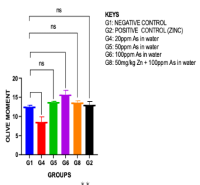
Arsenic is a ubiquitous environmental toxicant present in food, soil, water, and air, and is released into the environment from anthropogenic and man-made sources. The major inorganic forms of arsenic are arsenite and arsenate, while arsenite is more cytotoxic and genotoxic than arsenate. The study was to determine the extent of DNA damage by the ingestion of arsenic (in arsenic trioxide form) in the drinking water of female albino rats at varying concentrations and the ameliorative effect of zinc and selenium on the ingested arsenic trioxide. 90 female Wistar albino rats, 141.5 ± 3.68 g were randomized into 9 groups of 10 rats each and used for this study. The control groups were as follows: no treatment, 50mg/kg of Zn, and 200µg/kg of Se, while the treatment groups were: 20ppm of As, 50ppm of As, 100ppm of As, 200µg/kg of Se + 100ppm of As, 50mg/kg of Zn + 100ppm of As, and 200µg/kg of Se + 50mg/kg of Zn + 100ppm of As. DNA damage and the ameliorative effect of the supplements were assessed using Comet assays. DNA damage increased in the groups administered arsenic in this order: 20ppm < 50ppm < 100ppm. Significant DNA damage was observed in the group administered 100ppm of As (p<0.05), making arsenic a potent carcinogen. Group administered 100ppm As + 200µg/kg Se + 50 mg/kg Zn did not show any significant DNA damage. Oral administration of zinc and selenium was an excellent ameliorative agent both individually and synergistically on the genotoxic effect (carcinogenicity) of arsenic trioxide.
Downloads
Article Details
Section

This work is licensed under a Creative Commons Attribution-NonCommercial-NoDerivatives 4.0 International License.
How to Cite
References
1.Yamamoto S, Konishi Y, Matsuda T, Murai T, Shibata, MA, Matsui-Yuasa I. Cancer induction by an organic arsenic compound, dimethylarsinic acid (cacodylic acid), in F344/DuCrj rats after pre-treatment with five carcinogens. Cancer Res. 1995; 55(6): 1271–1276. PMID: 7882321.
2.Shi H, Hudson LG, Liu, KJ. Oxidative stress and apoptosis in metal ion-induced carcinogenesis. Free Radic. Biol. Med. 2004; 37(5): 582-593. Doi: 10.1016/j.freeradbiomed.2004.03.012. PMID: 15288116.
3.Flora SJS, Bhadauria S, Singh N, Kannan, GM. Arsenic induced oxidative stress and role of antioxidant supplementation during chelation: A review. J. Environ. Biol. 2007; 28(2 suppl): 333–347. PMID: 17929749.
4.Ratnaike RN. Acute and chronic arsenic toxicity. Postgrad Med J. 2003; 79(933): 391–396. Doi:10/1136/pmj.79.933.391. PMID: PMC1742758.
5.Lewis DR, Southwick JW, Ouellet Hellstrom R. Drinking water arsenic in Utah: a cohort mortality study. Environ Health Perspect. 1999; 107(5): 359–365. Doi:10.1289/ehp.99107359. PMID: 10210691; PMCID: PMC1566417.
6.Chowdhury UK, Biswas BK, Chowdhury TR, Samanta G, Mandal BK, Basu GC, Chanda CR, Lodh D, Saha KC, Mukherjee SK, Roy S, Kabir S, Quamruzzaman Q, Chakraborti D. Groundwater arsenic contamination in Bangladesh and West Bengal, India. Environ. Health Perspect 2000; 108(5): 393– 397. Doi:10.1289/ehp.00108393. PMID: 10811564; PMCID: PMC1638054.
7.Smith AH, Lingas EO, Rahman M. Contamination of drinking water of arsenic in Bangladesh: a publish health emergency. Bull World Health Organ. 2000; 78(9): 1093–1103. PMID:11019458; PMCID: PMC2560840.
8.Rossman TG. Arsenic In: Rom, WN Environmental and Occupational Medicine. Philadelphia: Lippencott Raven, 1998; pp. 1011–1019.
9.Chowdhury UK, Rahman MM, Mandal BK, Paul K, Lodh D, Biswas BK. Ground water contamination and human suffering in WB, India, and Bangladesh. Environ. Sci. 2001; 8(1): 393–415. http://sciencelinks.jp/j:east/article/200203/000020020302A0071360.php
10.World Health Organization (WHO). Guidelines for Drinking Water Quality. Vol 1: Recommendations, 2nd ed. Geneva: World Health Organization. 1993. https://iris.who.int/handle/10665/259956
11.Aposhian HV. Biochemical toxicology of arsenic. Americ. J Epidermol. 1989; 129: 265–299.
12.Mishra D, Mehta A, Flora SJ. Reversal of arsenic induced hepatic apoptosis with combined administration of DMSA and its analogues in guinea pigs: role of glutathione and linked enzymes. Chem Res Toxicol. 2008; 21(2): 400– 407. Doi: 10.1021/tx700315a. Epub 2007 Dec 29. PMID: 18163546.
13.Kalia K, Narula, GD, Kannan, GM, Flora, SJ. Effects of combined administration of captopril and DMSA on arsenite induced oxidative stress and blood and tissue arsenic concentration in rats. Comp Biochem Physiol C Toxicol Pharmacol. 2007; 144(4): 372–379. Doi:10.1016/j.cbpc.2006.11.001. Epub 2006 Nov 17. PMID: 17188940.
14.Liu XS, Athar M., Lippai I, Waldren C, Hei TK. Induction of oxyradicals by arsenic, implication for mechanism of genotoxicity. Proc Natl Acad Sci U.S.A. 2001; 98(4): 1643–1648. Doi: 10.1073/pnas.98.4.1643. Epub 2001 Feb 6. PMID:11172004; PMCID:PMC29310.
15.Halliwell B, Arouma OI. DNA and Free Radicals. New York: Ellis Harwood. 1993; 211–222.
16.Calderon J, Navarro ME, Jimernez-Capdeville ME, Santos-Diaz, MA, Golden A, Rodriguez-Leyva I. Exposure to arsenic and lead and neuropsychological development in Mexican children. Environ. Res. 2001; 85(2): 69–76. Doi:10.1006/enrs.2000.4106. PMID: 11161656.
17.Garcia-Chavez E, Jimenez I, Segura B, Del Razo, LM. Lipid oxidative damage and distribution of inorganic arsenic and its metabolite in the rat nervous system after arsenite exposure: influence of alpha tocopherol supplementation. Neurotoxicol. 2006; 27(6): 1024–1031. Doi:10.1016/j.neuro.2006.05.001. Epub 2006 May 7. PMID: 16797074.
18.Tchounwou PB, Patlolla AK Centeno JA. Carcinogenic and systemic health effects associated with arsenic exposure- A critical review. Toxicol Pathol. 2003; 31(6): 575-588. Doi: 10.1080/01926230390242007. PMID: 14585726.
19.Hei TK, Filipic M. Role of oxidative damage in the genotoxicity of arsenic. Free Radic Biol Med. 2004; 37(5): 574-581. Doi:10.1016/j.freeradbiomed.2004.02.003. PMID:15288115.
20.Kemper K, Minnatullah K. Towards a More Effective Operational Response. World Bank I. 2005; 1-68.
21.Nicomel NR, Leus K, Folens K, Van Der Voort P, Du Laing G. Technologies for arsenic removal from water: Current status and future perspectives. Int. J. Environ. Res. Public Health 2015; 13:1-24.
22.Wang S, Mulligan CN. Occurrence of arsenic contamination in Canada: Sources, behaviour and distribution. Sci. Total Environ. 2006; 366(2-3): 701-721. Doi: 10.1016/j.scitotenv.2005.09.005. Epub 2005 Oct 3. PMID:16203025.
23.Basu AK. DNA damage, mutagenesis and cancer. Int. J. Mol. Sci. 2018; 19(1): 970. Doi: 10.3390/ijms19040970. PMID: 29570697; PMCID: PMC5979367.
24.Weston A, Harris CC. Multistage Carcinogenesis. In: Kufe DW, Pollock RE, Weichselbaum, RR, eds. Holland-Frei Cancer Medicine. 6th Edition. Hamilton (ON): BC Decker. 2003. https://www.ncbi.nlm.nih.gov/books/NBK13982/.
25.De Bont R, van Larebeke N. Endogenous DNA damage in humans: a review of quantitative data. Mutagenesis. 2004; 19(3):169-185. Doi:10.1093/mutage/geh025. PMID: 15123782.
26.Hughes MF. Arsenic toxicity and potential mechanisms of action. Toxicol. Lett. 2002; 133(1): 1-16. Doi: 10.1016/s0378-4274(02)00084-x. PMID: 12076506.
27.Dedoussis GV, Kanoni S, Mariani E, Cattini L, Herbein G, Fulop T, Varin A, Rink L, Jajte J, Monti D, Marcellini F, Malavolta M, Mocchegiani E. Mediterranean diet and plasma concentration of inflammatory markers in old and very old subjects in the ZINCAGE population study. Clin Chem Lab Med. 2008; 46(7): 990-996. Doi: 10.1515/CCLM.2008.191. PMID: 18605965.
28.Kanoni S, Dedoussis GV, Herbein G, Fulop T, Varin A, Jajte J, Rink L, Monti D, Mariani E , Malavolta M, Giacconi R, Marcellini F, Mocchegiani E.. Assessment of gene-nutrient interactions on inflammatory status of the elderly with the use of a zinc diet score--ZINCAGE study. J Nutr Biochem. 2010; 21(6): 526-531. Doi: 10.1016/j.jnutbio.2009.02.011. Epub 2009 May 15. PMID: 19447023.
29.Rayman MP. Selenium in cancer prevention: A review of the evidence and mechanism of action. Proc Nutr Soc. 2005; 64(4):527-542. Doi: 10.1079/pns2005467. PMID: 16313696.
30.Erkekoglu P, Giray B, Rachidi W, Hininger-Favier I, Roussel AM, Favier A. Effects of di (2-ethylhexyl) phthalate on testicular oxidant/antioxidant status in selenium-deficient and selenium supplemented rats. Environ Toxicol. 2014; 29: 98-107. Doi:10.1002/tox.20776. Epub 2011 Oct 5. PMID: 21976414.
31.Singh NP, Coy MC. Metallothioneins. In: A simple technique for quantitation of low levels of DNA damage in individual cells. Exp. Cell Res. 1988; 175(1): 184-191. Doi: 10.1016/0014-4827(88)90265-0. PMID: 3345800.
32.Patlolla, A Tchounwou PB. Cytogenetic evaluation of arsenic trioxide toxicity in SpragueDawley rats. Mutat. Res. 2005; 587(1-2): 126-133. Doi:10.1016/j.mrgentox.2005.08.007. Epub 2005 Oct 5. PMID: 16213187.
33.Kaur R, Garkal A, Sarode L, Banjar P, Mehta T, Singh DP, Rawal R. Understanding arsenic toxicity: implications for environmental exposure and human health. J Hazar. Mater. Lett. 2024; 5. https://doi.org/10.1016/j.hazl.2023.100090.
34.Kaur R. Influence of heavy metals exposure on gut microbiota: recent advances. J Biochem. Mol. Toxicol. 2023; 1-7. Doi: 10.1002/jbt.23485.
35.Hughes MF, Beck BD, Chen Y, Lewis AS, Thomas DJ. Arsenic exposure and toxicology: a historical perspective. Toxicol. Sci. 2011; 123: 305-332. Doi: 10.1093/toxisci/kfr184
36.Bjorklund G, Rahaman SMd, Shanaida M, Lysiuk R, Oliynyk P, Lenchyk L, Chirumbolo S, Chasapis CT, Peana M. Natural dietary compounds in the treatment of arsenic toxicity. Molecules. 2022; 27(15): 4871. Doi: 10.3390/molecules 27154871. PMID: 35956821. PMCID: PMC9370003.
37.Vahter ME. Interactions between arsenic-induced toxicity and nutrition in early life 1.2. J Nutrit. 2007; 137(12): 2798-2804. Doi: 10.1093/jn/137.12.2798.
38.Moran B. Roles of mammalian glutathione peroxidase and thioredoxin reductase enzymes in the cellular response to nitrosative stress. Free Radic. Biol. Med. 2018; 127: 160-164. https://doi.org/10.1016/j.freeradbiomed.2018.01.028.
39.Maret W. The function of Zinc metallothionein: A link between cellular zinc and redox state. J Nutr. 2000; 130(5S Suppl):1455S-1458S. https://doi.org/ 10.1093/jn/130.5.1455S. PMID: 10801959
40.Yildiz A, Kaya Y, Tanriverdi O. Effect of the interaction between selenium and zinc on DNA repair in association with cancer prevention. J Cancer Prev. 2019; 24(3):146-154. https://doi.org/10.15430/jcp.2019.24.3.146
41.David Banji, Otilia JF, Madhav R, Annamalai AR. Impact of Zinc, Selenium and Lycopene on capsaicin mutagenicity and oxidative damage in mice. J Trace Elem Med Biol: Elsevier. 2013; 27(3): 230-235. Doi:10.1016/j.jtemb.2013.01.001. Epub 2013 Feb 4.
42.Zwolak I. The role of selenium in arsenic and cadmium toxicity: an updated review of scientific literature. Biol. Trace Elem. Res. 2020; 193: 44-63. https://doi.org/10.1007/s12011-019-01691-w