


Toxic Beauty: Evaluating the Toxicological Risks of Heavy Metals in Facial Cosmetics and Implications for Public Health in Calabar, Nigeria
Article Sidebar
Main Article Content
Abstract
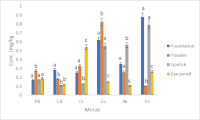
Facial cosmetics beautify, but combined usage may expose users to harmful heavy metals. This study evaluates that toxic risk. A survey involving 300 female participants was conducted to identify the most commonly used cosmetic brands—Brands A, B, C, and D. A total of 576 cosmetic samples, including foundations, face powders, lipsticks, and eye pencils, were purchased bimonthly over six months. Samples were prepared through acid digestion and analyzed for metal content using atomic absorption spectrophotometry. Health risk assessment was conducted using systemic exposure dosage (SED), margin of safety (MoS), hazard quotient (HQ), hazard index (HI), and lifetime cancer risk (LCR) models. Metals concentrations (mg/kg) across all brands were in the following ranges: lead (0.066-0.789), cadmium (0.093-0.787), chromium (0.049-0.543), cobalt (0.048-0.902), nickel (0.033-0.704), and iron (0.021-0.641). Metal concentrations varied significantly across brands and product types (ANOVA, p≤0.05). Nickel and cadmium levels in most products exceeded WHO and Health Canada limits. The SED values revealed that Co, Cd, and Pb posed the highest risks, particularly in Brand A and Brand C products. MoS calculations indicated that Cd and Co posed significant safety concerns. HQ values confirmed that Cd and Co exceeded the non-carcinogenic risk threshold. The HI values were above unity, suggesting cumulative health risks. LCR values for Cd, Ni, and Cr were above the acceptable risk range, indicating potential cancer risks. The study concludes that prolonged use of studied cosmetics poses both carcinogenic and non-carcinogenic risks. Routine screening of cosmetic products to ensure compliance with safety standards is strongly recommended.
Downloads
Article Details
Section

This work is licensed under a Creative Commons Attribution-NonCommercial-NoDerivatives 4.0 International License.
How to Cite
References
1.Naseem, M., Qureshi, A., Farooq, S. Toxic beauty: Heavy metal exposure through cosmetic products. J. Pub. Health Res. 2022; 27(4): 341–355.
2.Al-Saleh, I., Elkhatib, R., Al-Rajudi, T. Risk assessment of lead in cosmetic products. Env. Mon. and Ass. 2020; 192(4): 243. https://doi.org/10.1007/s10661-020-8191-7
3.Hajializadeh, F., Asadi, S., Tavakoli, M. Heavy metal contamination in cosmetics: Sources, toxic effects, and regulatory measures. Env. Sc. and Poll. Res. 2022; 29(5): 7430-7445. https://doi.org/10.1007/s11356-021-16065-x
4.Pan, Z., Zhou, W., Bai, Y. Toxicological risks of heavy metals in cosmetics: An integrative review. Reg. Tox. and
Pharm. 2021; 123: 104931. https://doi.org/10.1016/j.yrtph.2021.104931
5.Kumar, A., Tripathi, K. Functional benefits of incorporating vitamins and moisturizers in cosmetics: A scientific review. Cos and P. Care Res. 2021; 34(3): 147–159.
6.Panahi, M., Rezaei, M., Gholami, B. Intentional and unintentional incorporation of heavy metals in beauty products. Toxic Sub. J. 2022; 15(2): 134–148.
7.Cheng, W., Lin, H., Huang, Y., Zhao, J. Sources of heavy metals in cosmetics: A focus on manufacturing processes and environmental contributions. Env. Sc. and Poll. Res. 2023; 30(6): 5423–5435.
8.Jadhav, P., Sharma, R., Rao, V. Environmental factors contributing to heavy metal contamination in cosmetics. J. Env. Chem. 2021; 17(5): 302–311.
9.Tiwari, A., Mishra, N., Singh, P. Health risks associated with the use of heavy-metal-contaminated foundations and powders. Int. J. Pub. Health. 2023: 50(1): 85–95
10.Ali, M., Khan, R., Sheikh, F., Umar, A. Toxicological impact of heavy metal contamination in beauty products: A public health perspective. Tox. Res. 2022; 29(3): 112–127.
11.Rebelo, F. M., Caldas, E. D. Heavy metal toxicity in cosmetics: A review of health effects. Clin. Tox. J. 2016; 54(7): 617–631.
12. Naalbandi, M., Khalili, H., Sadeghi, P. Toxicity of chromium, nickel, and cobalt in cosmetics: A systematic review. J. Env. Health. 2016; 12(2): 88–102.
13.Jeevan, K., Sharma, R. Heavy metals in personal care products: A systematic review of health implications. Int. J. Cos. Sc. 2023: 45(1): 13-24. https://doi.org/10.1111/ics.12678
14.Al-Dayel, O., Hefne, J., Al-Ajyan, T. Analysis of toxic metals in cosmetic products and their health risk assessment. J. Env. H. Sc. and Eng. 2021; 19(3): 557-568. https://doi.org/10.1007/s40201-021-00653-3
15.Chouhan, S., Flora, G., Flora, S. Toxicity of heavy metals in cosmetics: A review. J. App. Tox. 2020; 40(12), 1655-1666. https://doi.org/10.1002/jat.4045
16.Gao, L., Zhou, Z., Xie, Y., Wang, F. Lead absorption through lipstick use: Implications for regulatory policy. Int. J. Tox. 2023; 42(2): 115–129.
17.Smith, J., Johnson, P. Dermal absorption of heavy metals: Factors influencing cosmetic safety. J. Skin Res. 2021; 22(4), 231–243.
18.Patel, R. The hidden dangers of lipstick consumption: Public awareness and health risks. J. Cons. Safety, 2016; 9(1): 5–12.
19.Iwegbue, C. M. A., Bassey, F. I., Obi, G., Tesi, G. O., Martincigh, B. S. Concentrations and exposure risks of some metals in facial cosmetics in Nigeria. Tox. Rep., 2016; 3: 464-72.
20.Udofia, U. U., Udiba U. U., Akpan E. R., Antai, E. E. Potential human health risk assessment of heavy metals intake through consumption of fluted pumpkin (Telfairiaoccidentalis) purchased from major markets in Calabar Metropolis, Nigeria. Iss. Bio. Sc. and Pharm. Res. 2020; 8(5): 85-97.
21.United States Environmental Protection Agency (US-EPA). Risk Assessment Guidance for Superfund. Washington, DC: US EPA. [Online]. 2011. [Cited 2024 Nov. 14]. Available from: https://www.epa.gov/superfund/superfund-risk-assessment
22.Kadiri, H. G., Etonihu, A. C., Opaluwa, O. D., Kigbu, P. E. A study of Toxic Metal Contents in Selected Cosmetics in the Federal Capital Territory and Products Safety Regulations in Nigeria. Cont. J. Appl. Sc, 2020; 15(2): 1-24.
23.Liu, S., Hammond, S. K., Rojas-Cheatham A. Concentrations and potential health risks of metals in lip products. Env. Health Persp, 2013; 121(6): 705-710.
24.El-Aziz R. A., Abbassy, M. M., Hosny G. Health risk assessment of some heavy metals in cosmetics in common use. Int. J. Env. Sc. and Tox. Rev., 2017; 5(3): 53-62.
25.World Health Organization. Environmental Health Criteria 238: Chromium. Geneva: WHO. [Online]. 2008. [Cited 2024 Nov. 14]. Available from: https://www.who.int/publications/i/item/Environmental-Health-Criteria-238
26.United States Environmental Protection Agency (US-EPA). Guideline for Carcinogenic Risk Assessment. EPA/630/P-03/001B. [Online]. 2005. [Cited 2024 Nov. 14]. Available from: https://www3.epa.gov/airtoxics/cancer_guidelines_final_3-25-05.pdf