


Protective Potential of Garcinia Cowa Roxb Fruit Peel Extract Against UVB-Induced Skin Damage in Rattus norvegicus Rats
Article Sidebar
Views | PDF/EPUB Downloads:
238
/ 82
/ 53
Main Article Content
Abstract
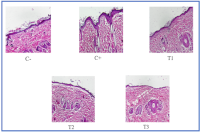
Garcinia cowa (G. cowa) Roxb., a medicinal plant used in traditional medicine, possesses antioxidant properties and contains bioactive compounds like flavonoids and vitamin C. This study examined the impact of G. cowa extract from the fruit rind on skin thickness, the number of fibroblast cells, and collagen density in Rattus norvegicus rats exposed to UVB light. Thirty rats were divided into five groups (six each) in a post-test randomized control design. The negative control group (C-) was not exposed to UVB; the positive control group (C+) was exposed to UVB. Three treatment groups (T1, T2, and T3) were exposed to UVB and treated with 3%, 5%, and 8% extracts, respectively, on the back skin. The extract was prepared by macerating 1015 g of the fruit rind with 96% ethanol at a 1:5 ratio for 2 × 24 hours. The results of histopathological analysis revealed several significant changes in each group compared to the control group (C+). Epidermal thickness decreased in all treatment groups: T1 decreased by 37.58%, T2 decreased by 46.22%, and T3 showed the most significant decrease of 58.73%. In contrast, the number of fibroblasts increased in each group: T1 increased by 44.44%, T2 increased by 55.56%, and T3 increased by 102.22%. Similarly, collagen density increased in all treatment groups: T1 by 18.79%, T2 by 9.11%, and T3 by 10.83%. Garcinia cowa Roxb fruit peel extract effectively prevents epidermal thickening, protects fibroblast cells from damage, and slows down the loss of collagen density.
Downloads
Article Details
Section

This work is licensed under a Creative Commons Attribution-NonCommercial-NoDerivatives 4.0 International License.
How to Cite
References
Wyles SP, Vyas K, Wasserburg JR, Ansaf R, Kirkland JL. Age-related disease: Skin. In: Aging [Internet]. Elsevier; 2024 [cited 2024 Aug 24]. p. 147–164. Available from: https://linkinghub.elsevier.com/retrieve/pii/B9780443155000000098 DOI: https://doi.org/10.1016/B978-0-443-15500-0.00009-8
2. Stoykova ID, Koycheva IK, Binev BK, Mihaylova LV, Benina MY, Alipieva KI, Georgiev MI. Myconoside and Calceolarioside E Restrain UV-Induced Skin Photoaging by Activating NRF2-Mediated Defense Mechanisms. IJMS. 2024 Feb 19;25(4):2441. DOI: https://doi.org/10.3390/ijms25042441
3. Ge Y, Li M, Bai S, Chen C, Zhang S, Cheng J, Wang X. Doxercalciferol alleviates UVB-induced HaCaT cell senescence and skin photoaging. Int. Immunopharmacol. 2024;127:111357. DOI: https://doi.org/10.1016/j.intimp.2023.111357
4. Liu S, You L, Zhao Y, Chang X. Hawthorn Polyphenol Extract Inhibits UVB-Induced Skin Photoaging by Regulating MMP Expression and Type I Procollagen Production in Mice. J Agric Food Chem. 2018;66(32):8537–4856.
5. Tong T, Geng R, Kang SG, Li X, Huang K. Revitalizing Photoaging Skin through Eugenol in UVB-Exposed Hairless Mice: Mechanistic Insights from Integrated Multi-Omics. Antioxidants. 2024 ;13(2):168-197. DOI: https://doi.org/10.3390/antiox13020168
6. Goh AP, Goh S, Tow W, Toh K, Palanisamy UD, Sundralingam U. Exploring the Role of Herbal Compounds in Skin Aging: A Systematic Review of Topical Approaches. Phytother. Res. 2024;ptr.8375. DOI: https://doi.org/10.1002/ptr.8375
7. Hang NTT, Thanh NV, Nhung NTH. Determination Of Some Kinds Of Important Ingredients Of Components and Biological Activity Of Garcinia Cowa Fruit. J. For. Sci. Technol. 2018;20(2):010-4.
8. Ritthiwigrom T, Laphookhieo S, Pyne SG. Chemical constituents and biological activities of Garcinia cowa Roxb. Maejo Int. J. Sci. Technol. 2013; 7(02), 212-231.
9. Minerva P, Hefni D. Determination of Vitamin C, Vitamin A and Flavonoid Levels in Garcinia cowa Roxb Fruit Flesh Extract. Int. J. Adv. Sci. Eng. Inf. Technol. 2022;12(4):1593-1598. DOI: https://doi.org/10.18517/ijaseit.12.4.16257
10. Draelos ZD. Cosmeceuticals. Dermatologic Clinics. 2019;37(1):107–115. DOI: https://doi.org/10.1016/j.det.2018.07.001
11. Pullar J, Carr A, Vissers M. The Roles of Vitamin C in Skin Health. Nutrients. 2017: ;9(8):866-872. DOI: https://doi.org/10.3390/nu9080866
12. Michalak M, Pierzak M, Kręcisz B, Suliga E. Bioactive Compounds for Skin Health: A Review. Nutrients. 2021;13(1):203-209. DOI: https://doi.org/10.3390/nu13010203
13. Zhang Q, Yang W, Liu J, Liu H, Lv Z, Zhang C, Chen D, Jiao Z. Identification of Six Flavonoids as Novel Cellular Antioxidants and Their Structure-Activity Relationship. Oxid Med Cell Longev. 2020;11(8):1–12. DOI: https://doi.org/10.1155/2020/4150897
14. Tungmunnithum D, Thongboonyou A, Pholboon A, Yangsabai A. Flavonoids and Other Phenolic Compounds from Medicinal Plants for Pharmaceutical and Medical Aspects: An Overview. Medicines. 2018;5(3):93-97. DOI: https://doi.org/10.3390/medicines5030093
15. Domaszewska-Szostek A, Puzianowska-Kuźnicka M, Kuryłowicz A. Flavonoids in Skin Senescence Prevention and Treatment. IJMS. 2022;22(13):6814-6822. DOI: https://doi.org/10.3390/ijms22136814
16. Ifora I, Rahmaddian T. Antioxidant Potential of Garcinia cowa Roxb. : A Review. IJPSM. 2022;7(9):20–26. DOI: https://doi.org/10.47760/ijpsm.2022.v07i09.003
17. Hefni D, Dachriyanus -, Wahyuni FS, Yerizel E, Arisanty D, Yusra LN. Cowanin, a Cytotoxic Xanthone from Asam Kandis (Garcinia cowa, Roxb.) Reduced Cell Migration and Induced Cell Cycle Arrest on T47D Human Cancer Cell. Int J Adv Sci Eng Inf Technol. 2020;10(5):2164–2169. DOI: https://doi.org/10.18517/ijaseit.10.5.12502
18. Pyne N, Ray R, Paul S. Computational and experimental approaches manifest the leishmanicidal potential of α-mangostin resourced from Garcinia cowa. Acta Tropica. 2024;257:107291. DOI: https://doi.org/10.1016/j.actatropica.2024.107291
19. Saba E, Kim SH, Lee YY, Park CK, Oh JW, Kim TH, Kim HK, Roh SS, Rhee MH. Korean Red Ginseng extract Ameliorates melanogenesis in humans and induces antiphotoaging effects in ultraviolet B–irradiated hairless mice. J. Ginseng Res. 2020;44(3):496–505. DOI: https://doi.org/10.1016/j.jgr.2019.05.003
20. Furqan M, Wahyuni FS, Susanti M, Hamidi D. Original Research Article Evaluation of Garcinia cowa Leaf Extract as A Potential Anticancer Agent: Cytotoxicity, Selectivity, and Apoptotic Effects on MCF-7/HER-2 Cells. Trop. J. Nat. Prod. Res. 2025; 9(2): 846-852
21. Pathak K, Saikia R, Das A. Unlocking the therapeutic potential of Garcinia cowa Rox. in diabetes management. Sciphy. 2023;2(1):38–41. DOI: https://doi.org/10.58920/sciphy02010038
22. Guerrero‐Navarro L, Jansen‐Dürr P, Cavinato M. Synergistic interplay of UV radiation and urban particulate matter induces impairment of autophagy and alters cellular fate in SENESCENCE‐PRONE human dermal fibroblasts. Aging Cell. 2024;23(4):e14086. DOI: https://doi.org/10.1111/acel.14086
23. Molecular Medicine Reports. [cited 2025 July 23]; Available from: http://www.spandidos-publications.com/10.3892/mmr/
24. Jo K, Bae GY, Cho K, Park SS, Suh HJ, Hong KB. An Anthocyanin-Enriched Extract from Vaccinium uliginosum Improves Signs of Skin Aging in UVB-Induced Photodamage. Antioxidants. 2020;9(9):844-857.
25. Liu S, You L, Zhao Y, Chang X. Hawthorn Polyphenol Extract Inhibits UVB-Induced Skin Photoaging by Regulating MMP Expression and Type I Procollagen Production in Mice. J Agric Food Chem. 2018;66(32):8537–46. DOI: https://doi.org/10.1021/acs.jafc.8b02785
26. Kwon OS, Jung SH, Yang BS. Topical Administration of Manuka Oil Prevents UV-B Irradiation-Induced Cutaneous Photoaging in Mice. J Evid Based Complementary Altern Med. 2013;2013:1–10. DOI: https://doi.org/10.1155/2013/930857
27. Her Y, Lee TK, Kim JD, Kim B, Sim H, Lee JC, Ahn JH, Park JH, Lee J, Hong J, Kim S, Won M. Topical Application of Aronia melanocarpa Extract Rich in Chlorogenic Acid and Rutin Reduces UVB-Induced Skin Damage via Attenuating Collagen Disruption in Mice. Molecules. 2020;25(19):4577-4591. DOI: https://doi.org/10.3390/molecules25194577
28. Wang PW, Cheng YC, Hung YC, Lee CH, Fang JY, Li WT, Wu Y, Pan T. Red Raspberry Extract Protects the Skin against UVB-Induced Damage with Antioxidative and Anti-inflammatory Properties. Oxid Med Cell Longev. 2019;2019:1–14. DOI: https://doi.org/10.1155/2019/9529676
29. Hamdan YM, Madirov EI, Marisov MA, Shamsutdinov NI, Zelenikhin PV, Nizamutdinov AS, et al. Study of the effect of laser pulse duration in the ultraviolet spectral range on fibroblasts. In: 2022 International Conference Laser Optics (ICLO) [Internet]. Saint Petersburg, Russian Federation: IEEE; 2022 [cited 2025 June 2]. p. 1–1. Available from: https://ieeexplore.ieee.org/document/9840320/
30. Dorr MM, Rochette PJ. Reduction of DNA damage repair efficiency and accumulation of residual damage following chronic UVB-irradiation of HaCaT cells. McKay BC, editor. PLoS ONE. 2023;18(4):e02835 DOI: https://doi.org/10.1371/journal.pone.0283572
Geng R, Guo J, Lao Y, Kang SG, Huang K, Tong T. Chronic UVB exposure induces hepatic injury in mice: Mechanistic insights from integrated multi-omics. Environ. Pollut. 2024;362:124933. DOI: https://doi.org/10.1016/j.envpol.2024.124933
32. Gary AS, Rochette PJ. Apoptosis, the only cell death pathway that can be measured in human diploid dermal fibroblasts following lethal UVB irradiation. Sci Rep. 2020;10(1):18946. DOI: https://doi.org/10.1038/s41598-020-75873-1
33. Yang X, Wang J, Wang H, Li X, He C, Liu L. Metabolomics study of fibroblasts damaged by UVB and BaP. Sci Rep. 2021;11(1):11176. DOI: https://doi.org/10.1038/s41598-021-90186-7
34. Jo K, Bae GY, Cho K, Park SS, Suh HJ, Hong KB. An Anthocyanin-Enriched Extract from Vaccinium uliginosum Improves Signs of Skin Aging in UVB-Induced Photodamage. Antioxidants. 2020;9(9):844-857. DOI: https://doi.org/10.3390/antiox9090844
35. Zheng SL, Wang YM, Chi CF, Wang B. Chemical Characterization of Honeysuckle Polyphenols and Their Alleviating Function on Ultraviolet B-Damaged HaCaT Cells by Modulating the Nrf2/NF-κB Signaling Pathways. Antioxidants. 2024;13(3):294-315. DOI: https://doi.org/10.3390/antiox13030294
36. Abate M, Pagano C, Masullo M, Citro M, Pisanti S, Piacente S, et al. Mangostanin, a Xanthone Derived from Garcinia mangostana Fruit, Exerts Protective and Reparative Effects on Oxidative Damage in Human Keratinocytes. Pharmaceuticals. 2022;15(1):84-100. DOI: https://doi.org/10.3390/ph15010084
37. Dike M, Thergoankar R, Deodhar M. Screening of various extracts of Garcinia indica viz., leaf, seed, stem, root and fruit for UV protective activity and incorporation of extracts in sun protective formulations. Acta Hortic. 2019;(1241):639–646. DOI: https://doi.org/10.17660/ActaHortic.2019.1241.94
38. Figueiredo SA, Vilela FMP, Silva CAD, Cunha TM, Dos Santos MH, Fonseca MJV. In vitro and in vivo photoprotective/photochemopreventive potential of Garcinia brasiliensis epicarp extract. J Photochem Photobiol B. 2014;131(6):65–73. DOI: https://doi.org/10.1016/j.jphotobiol.2014.01.004
39. Dunaway S, Odin R, Zhou L, Ji L, Zhang Y, Kadekaro AL. Natural Antioxidants: Multiple Mechanisms to Protect Skin From Solar Radiation. Front Pharmacol. 2018;9:358049. DOI: https://doi.org/10.3389/fphar.2018.00392
40. Minerva P, Febriyenti F, Amelia R, Maidawilis M, Sukma Rita R, Alimuddin A. Phenolic content, antioxidant activity, and tyrosinase inhibitor potential for both skin and physical health: test of extract, skin content and content of Garcinia cowa fruit. Retos. 2024;62:10–15. DOI: https://doi.org/10.47197/retos.v62.108965
41. Boo YC. Ascorbic Acid (Vitamin C) as a Cosmeceutical to Increase Dermal Collagen for Skin Anti-aging Purposes: Emerging Combination Therapies. Antioxidants. 2022;11(9):1663-1681. DOI: https://doi.org/10.3390/antiox11091663
42. Yang L, Liu X, Zhang N, Wu G, Chen L, Xu J, Ren X, Jiang X, Huang Z. Flavonoids in Resina Draconis protect against pulmonary fibrosis via the TGF-β1/NOTCH1 pathway. Mol Cell Toxicol. 2020;16(2):193–201. DOI: https://doi.org/10.1007/s13273-019-00070-9
43. Merecz-Sadowska A, Sitarek P, Kucharska E, Kowalczyk T, Zajdel K, Cegliński T, Zajdel R. Antioxidant Properties of Plant-Derived Phenolic Compounds and Their Effect on Skin Fibroblast Cells. Antioxidants. 2021;10(5):726-750. DOI: https://doi.org/10.3390/antiox10050726
44. Samivel R, Nagarajan RP, Subramanian U, Khan AA, Masmali A, Almubrad T, Akhtar S. Inhibitory Effect of Ursolic Acid on Ultraviolet B Radiation-Induced Oxidative Stress and Pro-inflammatory Response-Mediated Senescence in Human Skin Dermal Fibroblasts. Oxidative Medicine and Cellular Longevity. 2020;2020:1–17. DOI: https://doi.org/10.1155/2020/1246510
45. Song B, Liu D, Liu TC, Li K, Wang S, Liu J, Regenstein JM, Wu Y, Zhou P. The combined effect of commercial tilapia collagen peptides and antioxidants against UV-induced skin photoaging in mice. Food Funct. 2023;14(13):5936–5948. DOI: https://doi.org/10.1039/D3FO01516E
46. Tominaga K, Hongo N, Fujishita M, Takahashi Y, Adachi Y. Protective effects of astaxanthin on skin deterioration. J Clin Biochem Nutr. 2017;61(1):33–39. DOI: https://doi.org/10.3164/jcbn.17-35
47. Fan Z, Zhou Y, Gan B, Li Y, Chen H, Peng X, Zhou Y. Collagen‐EGCG Combination Synergistically Prevents UVB‐Induced Skin Photoaging in Nude Mice. Macromol. Biosci. 2023;23(12):2300251. DOI: https://doi.org/10.1002/mabi.202300251
48. Pattananandecha T, Apichai S, Julsrigival J, Ungsurungsie M, Samuhasaneetoo S, Chulasiri P, Kwankhao P, Pitiporn S, Ogata F, Kawasaki N, Saenjum C. Antioxidant Activity and Anti-Photoaging Effects on UVA-Irradiated Human Fibroblasts of Rosmarinic Acid Enriched Extract Prepared from Thunbergia laurifolia Leaves. Plants. 202;10(8):1648-1656. DOI: https://doi.org/10.3390/plants10081648
49. Goik U. Witamina C i jej pochodne w utrzymaniu dobrej kondycji skóry. Postepy Biochem. 2024;70(3):307–314. DOI: https://doi.org/10.18388/pb.2021_554
50. Triangga Apsari KJ, Dewi Ratnayanti IGA, Arijana IGKN, Sugiritama IW. Topical application of purple cabbage (Brassica oleracea L. var. capitata f. rubra) ethanol cream extract of dermic collagen on male Wistar rats (Rattus norvegicus) exposed to ultraviolet B. Intisari Sains Medis. 2020;11(1):253–258. DOI: https://doi.org/10.15562/ism.v11i1.206
51. Sun J, Jiang Y, Fu J, He L, Guo X, Ye H, Yin C, Li H, Jiang H. Beneficial Effects of Epigallocatechin Gallate in Preventing Skin Photoaging: A Review. Molecules. 2024;29(22):5226-5248. DOI: https://doi.org/10.3390/molecules29225226
52. Han J, Jang K, Park M, Myung C. Garcinia cambogia suppresses adipogenesis in 3T3‐L1 cells by inhibiting p90RSK and Stat3 activation during mitotic clonal expansion. J Cell Physiol. 2021;236(3):1822–1839. DOI: https://doi.org/10.1002/jcp.29964